
The Border Collie is one of the most popular working breeds in Singapore, and most owners discover quickly how sensitive these dogs are. A dog bred to notice every small change in a flock of sheep now lives with lift doors, PMDs, food-delivery riders and renovation drilling. That mix shapes almost every behaviour problem we see in them.
We looked back at the dogs that came to us for behaviour help in Singapore and compared the Border Collies with every other dog in our cases. This guide shares what stood out, what published research says about each finding, and how we train Border Collies to cope with city life.
Border Collies in Singapore
Border Collies were developed in the hill country of Britain to gather and move sheep at a distance. A good working dog reads tiny shifts in the flock, holds the sheep with an intense stare known as “the eye”, and responds to quiet signals from a handler far away.
That background shows in the research. A large study of breed differences found that trainability and predatory chasing are among the most strongly inherited behaviours across breeds. When researchers went looking for dogs that can learn the names of dozens of toys, most of the gifted word learners they found were Border Collies, although the same researchers stress that the talent is rare even within the breed.
In Singapore, those traits meet a very different environment. Lifts open onto strangers, corridors turn blind corners, park connectors stream with bicycles and scooters, and the heat limits how long a dog can run. It’s crucial to note that these are patterns across the breed, and they don’t predict how any one dog will turn out. Plenty of Border Collies cope well with city life, and every dog needs to be assessed as an individual. Knowing where the breed’s sensitivity tends to show up makes it much easier to get ahead of problems.
What We See in Our Cases
We compared the problems recorded for the Border Collies we’ve worked with against every other dog in our behaviour cases in Singapore.
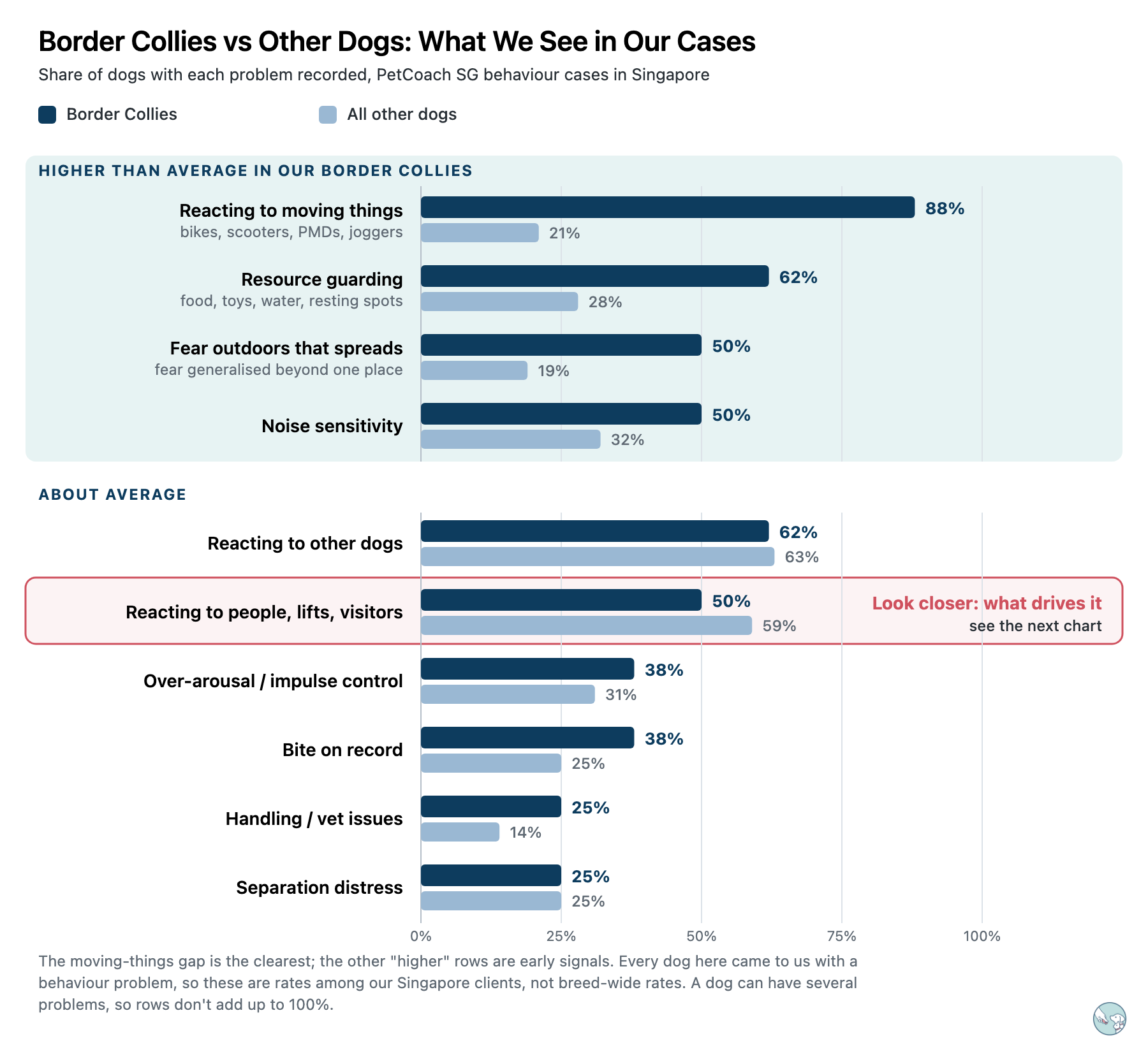
Every dog in this comparison came to us because of a behaviour problem, so these numbers describe our own clients in Singapore. We treat them as clues about where the breed tends to struggle here.
- Clearly higher: reacting to moving things.
- Also higher in our cases: resource guarding, fear outdoors that spreads, and noise sensitivity.
- About the same as other dogs: reacting to other dogs, separation distress, over-arousal, handling at the vet, and bites.
- About average, but worth a closer look: reacting to people and lifts.
Our sample lines up well with research elsewhere. A Finnish study of 13,700 dogs found noise sensitivity in 32% of dogs, the same rate we see in the non-Border Collies in our cases.
Where They Match Other Dogs
Our Border Collies were no more likely than other dogs to react to other dogs. Reactions to other dogs showed up in about six in ten dogs across the board, whatever the breed. Separation distress also came up at the same rate as everyone else, in about a quarter of dogs.
Both problems tend to grow from experience and management: a bad encounter on a walk, frustration on the leash, or a dog that was never taught to be comfortable alone. The general advice in our guides to reactive dog training and separation anxiety applies to Border Collies too.
Reacting to Moving Things
Nearly nine in ten of the Border Collies in our cases reacted to moving things like bicycles, scooters, joggers and trolleys. Among all the other dogs we see, it was about one in five. Other herding breeds such as Australian Shepherds and Shelties sat in between, at about half.
That gradient matches how these dogs were bred. Every dog carries the same hunting sequence: orient, eye, stalk, chase, grab, bite. Herding breeding strengthened the early part of that sequence and toned down the bites that come after, as Raymond Coppinger describes in How Dogs Work. A Border Collie is primed to lock on and chase anything that moves fast.
Research backs up the link. A 2025 genetics study found a gene variant in working-line Border Collies linked to more stalking, chasing and grab-biting. The Finnish study found Border Collies had the highest rates of staring and chasing lights or shadows of the 14 breeds it compared.
On a leash, the chase has nowhere to go. The dog locks on, the bicycle flies past, and the frustration comes out as barking and lunging. Singapore’s park connectors and food-delivery routes supply a steady stream of these triggers. In the dogs where we know when it started, it usually began in adolescence, somewhere between six and twelve months old.
Our guide to Border Collie prey drive explains the full sequence, why the leash blocks it, and how we give that drive a legal outlet.
Lifts, Corners and Sudden Change
Some reactions happen when something changes suddenly and up close. A lift door opens on a stranger, someone walks round a blind corner, or a guest stands up from the sofa. We call this sudden environmental contrast, or SEC. A herding dog was selected to notice this kind of change in the flock and to respond to it.
Reacting to people, lifts and visitors is common in every group we see, which tells us a lot of it comes from Singapore living. What stood out in our Border Collies was the reason behind the reaction.
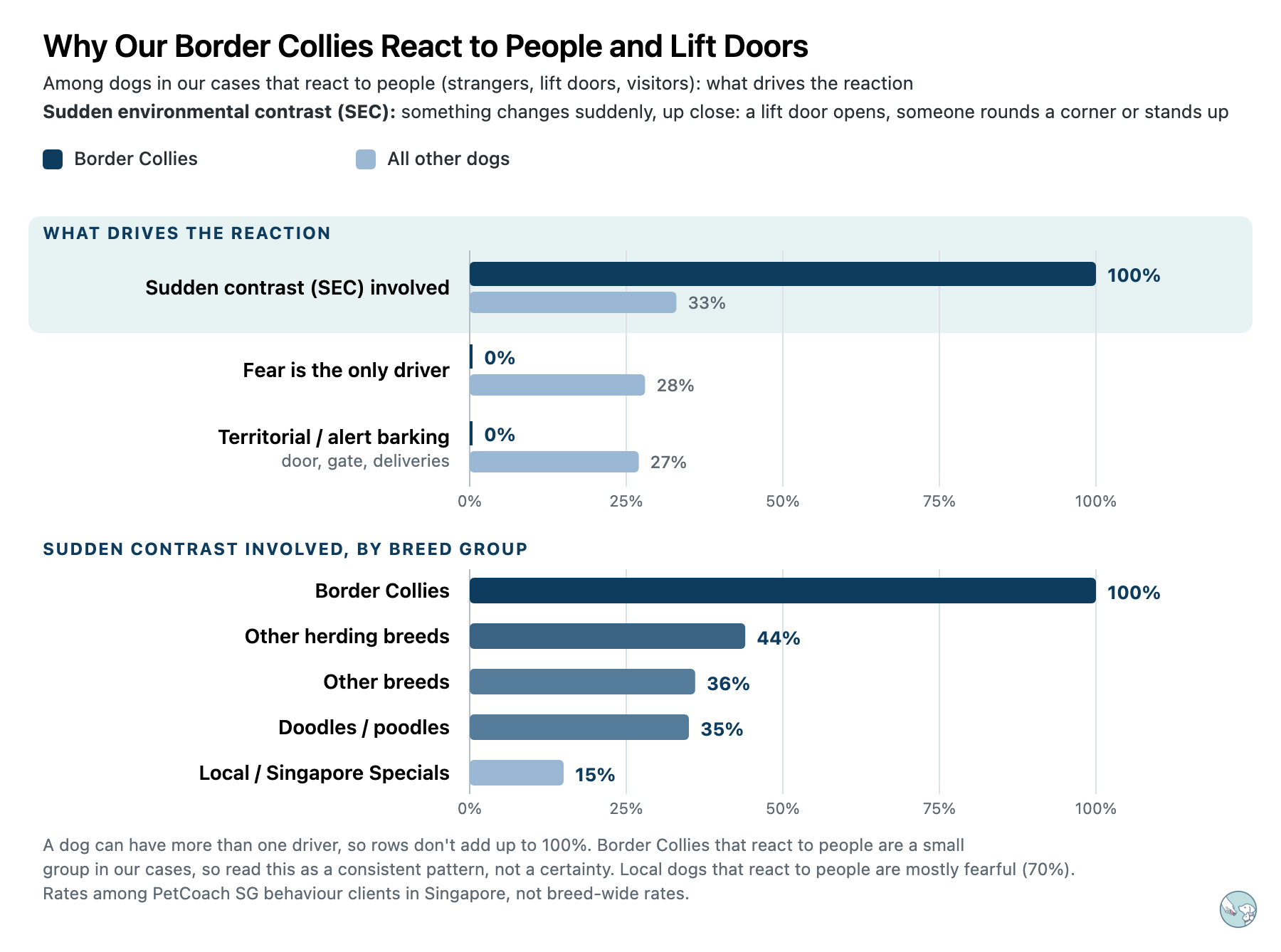
Every Border Collie in our cases that reacted to people did so through sudden contrast. Some of them were fearful too, and in every one of those dogs the sudden-contrast reaction was there as well. Local dogs showed the opposite pattern: most of the Singapore Specials who reacted to people were fearful, and sudden contrast was rare. We haven’t found published research on herding breeds and sudden change, so this part comes from our own cases.
The difference matters for training. A fearful dog needs distance and a slow build of confidence. A Border Collie reacting to sudden contrast does better with a predictable routine at the exact moment of change. In our cases, what helped was a set routine at doorways and lifts, and the handler taking over the “watching” job by standing between the dog and the person. Our article on Singapore-specific triggers shows how the lift can also become a cue for dogs with separation anxiety.
Noise, Guarding and Fear
Three other problems came up more often in our Border Collies than in other dogs. None of them has been shown to be a Border Collie trait in published research, so we explain each one through what research says about how it develops.
Noise Sensitivity
Half of our Border Collies were noise sensitive, compared with about a third of other dogs. Other herding breeds in our cases were high too, which suggests a herding pattern.
The outside evidence is mixed. Noise sensitivity is common in dogs generally: the Finnish study found it in 32% of dogs, matching our other dogs. Veterinary behaviourist Nicholas Dodman has reported herding breeds over-represented among dogs afraid of thunderstorms, but that large Finnish survey didn’t single Border Collies out.
Fear of one noise often spreads to others. A study of more than 5,000 dogs found that dogs afraid of one kind of noise were more likely to fear others. In Singapore, that list can include renovation drilling, construction, thunderstorms, rubbish chutes and lift sounds. Building calm around sound early is worth the effort with this breed. Storms need their own approach, which our guide to thunderstorm phobia covers.
Resource Guarding
Guarding came up in about six in ten of our Border Collies, compared with under a third of other dogs. In each case, something in the dog’s history stood out: a long stretch of confinement, a frightening medical ordeal, a busy dog run with competition for balls and water, or another dog living in the home.
Research on guarding points the same way. A study of more than 3,000 dog owners by Jacobs and colleagues linked guarding to how food is managed, especially taking it away during meals, to living with other dogs, and to fear and impulsivity. It found no link to any particular breed.
In our experience, an attentive dog that learns quickly can also learn quickly that something needs protecting. We prevent it with a few simple habits. Avoid taking food away, trade up for something better instead, add food to the bowl while the dog eats, and teach a “drop” that always pays well.
Fear That Spreads
Half of our Border Collies showed fear outdoors that had spread beyond one place, compared with about one in five other dogs. In most of them, it traced back to a single bad experience: an attack by another dog, harsh handling by a previous trainer, or a frightening medical event.
One frightening experience can be enough to create a lasting fear, and that fear can spread to similar places and situations. There’s no evidence that Border Collies learn fear faster than other dogs. The breed-differences study found general fearfulness among the least inherited traits, and the Finnish study didn’t list Border Collies among its most fearful breeds.
That makes this a problem we can do a lot to prevent. Protecting a young dog from frightening experiences, and avoiding harsh tools, matters more than anything in the dog’s pedigree. For dogs already affected, our guide to counterconditioning explains how we rebuild positive feelings step by step.
How We Train Border Collies
Training Border Collies works best when we give their sensitivity and drive a job to do. Exercise helps, and a tired Border Collie is still a sensitive one. A Border Collie with clear routines and a legal outlet for its drive copes far better with a busy city.
Storm, our Australian Shepherd, is another herding dog with the same sensitivity to sudden change. The first part of this clip shows him reacting at a lift lobby. In the second part, he has a clear job to put that energy into: a guard behaviour, tucked in between our legs, while we make sure the trigger never comes close. With that job to do, he copes calmly. Our guide to reactive dog training techniques explains this middle position in more detail.
Structure at Transitions
Most sudden-contrast reactions happen at a transition: a lift door, a doorway, a corner, the step from open space into a corridor. We give the dog a set routine at each one, so it knows what happens next. That might be a reorient to the handler at every doorway, or a fixed position in the lift with a reward as the doors open.
In our cases, a routine like this made a clear difference. One dog’s aggression at doorway transitions stopped within three sessions, and another dog’s lift reactivity improved a great deal once she had a lift routine.
An Outlet for the Chase
A Border Collie that can’t chase anything will look for something to chase. We use tug and fetch as rewards, so the dog gets to finish the sequence in a game with us. Our guide to tug and fetch in training shows how to set this up with clear rules.
For dogs reacting to traffic, we pair this with pattern games. With one dog, a “look at that” game and a simple back-and-forth pattern on walks had her car reactions largely settled within a few sessions.
Teaching an Off Switch
Many Border Collies struggle to settle. More exercise often makes this worse, because it builds a fitter dog with the same restless habits. We teach settling as a skill, reward calm, and add mental work alongside physical exercise. Scent work suits the breed well, and our guide to canine fitness covers exercise that builds the body without winding the dog up.
Obedience Under Drive
Border Collie obedience training only counts when it works with movement around. We build recall, leave it and sit in calm places first, then add moving distractions gradually. A “switch” from food to toys and a call-away recall also help with dogs that guard things at dog runs. Border Collies also dominate the obedience ring, and our article on Border Collies in obedience competition explains why.
Protecting From Bad Experiences
Several of the fearful Border Collies we’ve seen had been trained with harsh methods before they came to us. Their sensitivity means one bad experience can shape their behaviour for years. We avoid harsh tools, plan early outings so the dog isn’t overwhelmed, and handle food the way the guarding research suggests.
Before You Get a Border Collie
Most people searching for a Border Collie in Singapore are still deciding whether the breed fits their life. These are the practical questions we hear most.
HDB and Housing
Border Collies aren’t on HDB’s list of approved dog breeds, so they need to live in private property such as a condo or landed home. HDB allows one approved dog per flat, with fines of up to S$4,000 for breaking the rules. The Shetland Sheepdog is on the approved list, which is worth knowing if you want a herding breed in an HDB flat.
Condo living still means lifts, corridors and neighbours, so the sudden-contrast work above applies to most Border Collies here.
Heat and Exercise
In a large UK study of heatstroke in dogs, three in four cases happened during exercise, and only about one in twenty in hot cars. For an energetic dog in Singapore, the timing and intensity of exercise matter most. We suggest early morning or late evening walks, shade and water, and stopping at the first sign of heavy panting or slowing down.
Daily Workload
A young Border Collie needs a mix of physical exercise, training and mental work every day, plus time to rest. A typical day might include a cool-hours walk, two or three short training sessions, a scent or puzzle game, and a structured settle at home. Long, exciting runs alone tend to produce a fitter dog that still can’t switch off.
Importing a Puppy
Importing a puppy ethically from a responsible overseas breeder usually costs around S$10,000 to S$12,000 all in, including the puppy itself.
Where the puppy comes from changes the process a lot. AVS’s import rules group countries into three schedules.
- Australia, New Zealand, the UK and Ireland: there’s no rabies vaccine or blood test requirement and no quarantine, provided every condition is met.
- France, most of Europe, the USA and Japan: the puppy needs a rabies vaccination and a blood test showing enough antibodies, taken at least 90 days before the flight. A puppy bought overseas also does at least 10 days of home quarantine. In practice, these puppies are usually around six to seven months old before they can fly.
- All other countries: at least 30 days at the Animal Quarantine Centre.
The money goes on the puppy, vet work before export, an airline-approved crate, air cargo through a pet transport company, and Singapore fees. Those fees include a dog licence (S$15 a year if sterilised, S$90 if not), an import licence (S$50), a booked arrival inspection, and home quarantine where it applies. Ask at least two pet transport companies for written quotes.
A puppy from Europe spends its whole early socialisation period with the breeder. The American Veterinary Society of Animal Behavior calls the first three months the most important time for socialisation. Ask the breeder how they’ll get the puppy used to traffic, people and noise. In our cases, an unsettled start often shows up later. Ask to see the parents’ health test results too, and be wary of any breeder who will sell overseas without asking about your home and lifestyle.
Adopting Locally
Border Collies and Border Collie crosses do come up for adoption in Singapore. Ask the rescue about the dog’s history, its triggers and how it copes with lifts and traffic. Many of the dogs we see with fear outdoors had one bad experience behind it, and knowing that early makes training much easier.
Frequently Asked Questions
Are Border Collies allowed in HDB flats?
No. Border Collies aren’t on HDB’s approved breed list, so in Singapore they need to live in private property such as a condo or landed home. HDB allows one dog from its approved list per flat.
Why does my Border Collie chase bikes?
Border Collies were bred to lock onto and chase movement to herd sheep. On a leash the chase is blocked, and that frustration often comes out as barking or lunging. In our cases, this usually starts in adolescence. A legal outlet for the chase, such as tug or fetch, plus structured training on walks helps a lot.
Why does my Border Collie bark at the lift?
In our cases, Border Collies that react at lifts are usually responding to the sudden change of the doors opening onto a person up close. Fear alone was rarely the reason. A set routine in the lift, with a reward as the doors open, gives the dog something predictable to do at that moment.
Are Border Collies good for first-time owners?
They can be, with the right preparation. Border Collies learn quickly and love to work, but their sensitivity to movement, noise and sudden change takes planning in Singapore. First-time owners do best when they start training early and get help at the first sign of reactivity.
How do Border Collies cope with the heat?
Most heatstroke in dogs happens during exercise, so timing matters more than anything. Walk in the early morning or late evening, keep to shade, carry water, and stop at the first sign of heavy panting. Mental work indoors helps on hot days.
How much does a Border Collie cost?
Importing a puppy ethically from a responsible overseas breeder costs around S$10,000 to S$12,000 all in, including the puppy, vet work, transport and Singapore fees. Puppies from Europe or the USA need a rabies blood test and home quarantine, which adds time and cost.
Help for Your Border Collie
If your Border Collie is reacting to bikes, lifts or noise, early help makes a big difference. Our behaviour consults start with an assessment of what’s driving your dog’s behaviour, then build a plan around your home and routine. You can also browse all our training services.
Sources
- MacLean, E. L. et al. (2019). Highly heritable and functionally relevant breed differences in dog behaviour. Proceedings of the Royal Society B. doi:10.1098/rspb.2019.0716
- Salonen, M. et al. (2020). Prevalence, comorbidity, and breed differences in canine anxiety in 13,700 Finnish pet dogs. Scientific Reports, 10, 2962. PMC7058607
- Jeong, H., Ostrander, E. A. & Kim, J. (2025). Genomic evidence for behavioral adaptation of herding dogs. Science Advances, 11(18). doi:10.1126/sciadv.adp4591
- Storengen, L. M. & Lingaas, F. (2015). Noise sensitivity in 17 dog breeds. Applied Animal Behaviour Science, 171, 152–160. AVSAB summary
- Jacobs, J. A. et al. (2018). Factors associated with canine resource guarding behaviour in the presence of people. Applied Animal Behaviour Science, 208, 59–72.
- Hall, E. J., Carter, A. J. & O’Neill, D. G. (2020). Dogs don’t die just in hot cars: exertional heat-related illness (heatstroke) is a greater threat to UK dogs. Animals. PubMed 32751913
- Fugazza, C. et al. (2021). Gifted word learner dogs study, Scientific Reports. Eötvös Loránd University summary: ELTE
- Dodman, N. Thunderstorm phobia in dogs: an update. Veterinary Practice News. Link
- Coppinger, R. & Feinstein, M. (2015). How Dogs Work. University of Chicago Press.
- American Veterinary Society of Animal Behavior. Puppy Socialization Position Statement. AVSAB
- Animal & Veterinary Service (AVS), NParks. Importing dogs and cats; Licence fees
- Housing & Development Board. Keeping pets
