
Your Border Collie stands quietly in the lift lobby. The doors slide open on a stranger, and in a split second the dog is lunging and barking. Or the evening has been calm with friends over, until one of them gets up from the sofa to grab a drink.
We call this sudden environmental contrast. The dog is reacting to the change itself: something that wasn’t there a moment ago, or someone who suddenly moved.
When we looked back at our cases for our guide to Border Collie training in Singapore, every Border Collie we’d worked with that reacted to people did it this way. Here’s what sudden contrast is, why herding dogs are so tuned to it, how to tell it apart from fear, and the routines that helped our dogs.
What Sudden Contrast Means
Every dog keeps a running picture of what’s around it: the people in the room, the dogs at the park, the usual sounds of the block. Once something is part of that picture, the dog can relax around it. Sudden contrast is a reaction to something that breaks the picture without warning, like a lift door opening, someone rounding a corner, a guest standing up or a person walking up from behind.
Ten people chatting in a living room can be fine. The guest who arrives an hour late, or the one who suddenly stands, is the one the dog reacts to. It happens with dogs too: one dog appearing at the far end of a quiet park can set off a dog that ignored dozens at a busy dog run.
What matters is how much the change stands out. Distance plays a part, but a person 10 metres away on an empty field can stand out more than one brushing past in a crowd.
Why Herding Dogs Notice Change
A sheepdog’s job is to track a whole flock and respond the moment one sheep breaks away. Generations of breeding for that job produced dogs that notice small changes fast. The same attention that makes a Border Collie good at herding sheep makes a lift door hard to ignore.
Tuned to Movement
Border Collies are bred to watch, track and respond to movement, which our guide to Border Collie prey drive covers in depth. In a survey of 13,700 Finnish pet dogs, staring was more common in Border Collies than in any of the other 13 breeds. A large study of breed behaviour found that differences in aggression toward strangers are among the most strongly inherited differences between breeds.
Neither study looked at sudden change directly, and we haven’t found published research that does. What we describe here comes from our own cases.
Why Home Is Harder
Near home, the dog’s picture of normal is detailed. It knows the neighbours, the parked cars and the usual delivery riders, so anything new stands out sharply. In an unfamiliar place, everything is new, and one more new thing barely registers.
Home is also where most dogs have reacted most often, and that sensitises them to the place itself. After enough reactions near the block, the dog expects triggers there. It steps out of the lift already scanning, and that anticipation lowers its threshold before anything has appeared.
The handler is part of that picture too. If one person does most of the walks, most of the dog’s reactions have happened with that person on the other end of the leash, so their presence becomes part of what the dog expects. When a different handler takes over, the anticipation drops, the threshold isn’t as low, and the dog often reacts less.
One Border Collie we worked with reacted to motorbikes and cars mostly near home, and her threshold dropped further whenever her main handler was walking her. Owners often tell us their dog is fine at the park but difficult in their own block, and this is usually the reason.
Busy vs Quiet Places
The same logic explains why many reactive dogs cope better in busy places. In a shopping mall, people move in every direction all the time, so no single person stands out and there’s nothing for the dog to fix on. A dog that reacts to other dogs can walk through a pet fair surprisingly calmly for the same reason: there are dogs everywhere, so no one dog is a change.
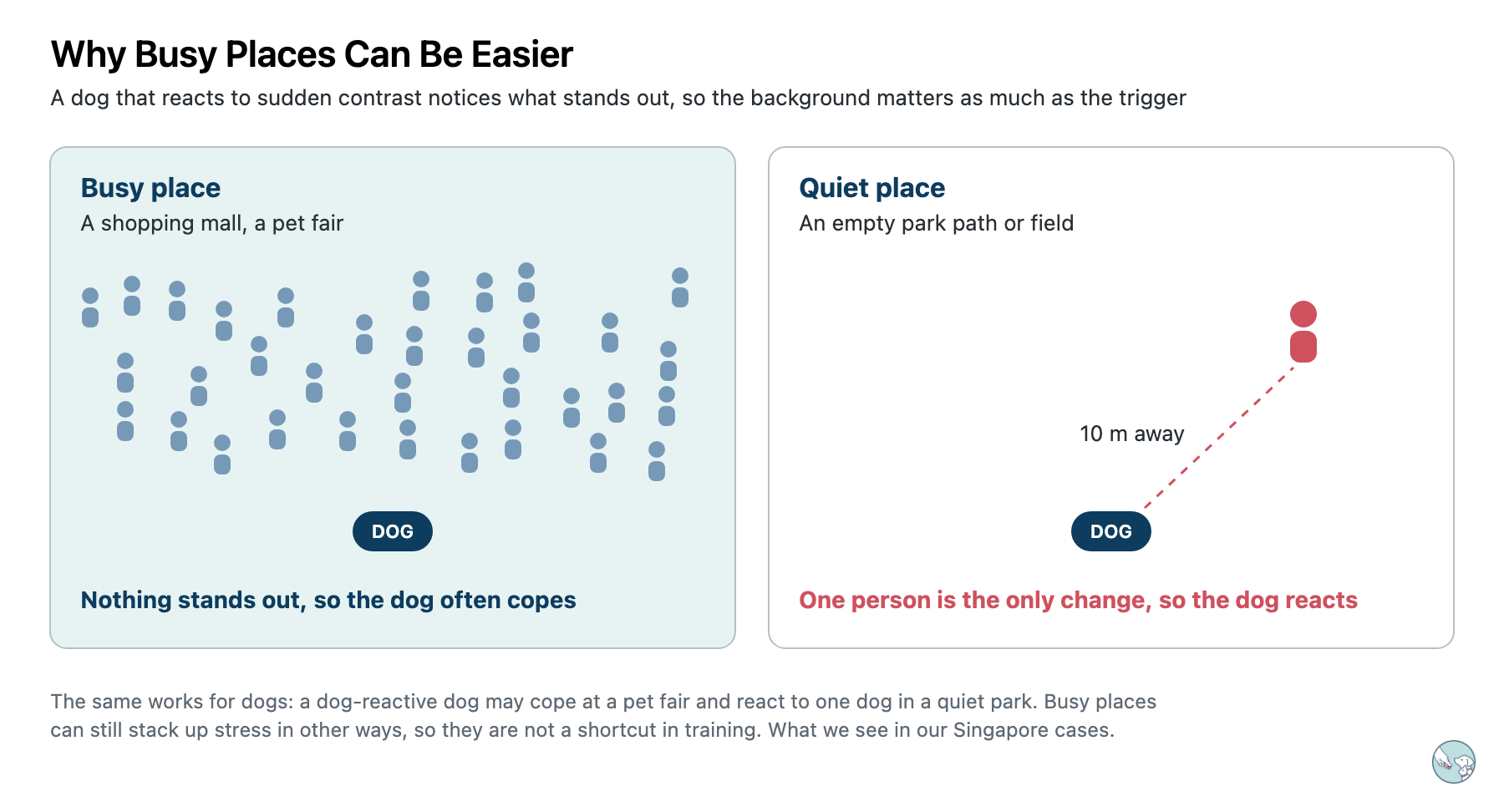
Take that same dog to a quiet park. One dog appears at the end of the path, it’s the only thing that has changed, and the dog reacts. On an empty field, someone walking past 10 metres away can be enough. A busy place still isn’t a shortcut in training. Crowds can stack up stress in other ways, and a dog that copes at the mall still needs work in the quiet places where it reacts.
When Reacting Works
The stranger in the lift always gets out at their floor, and the guest always sits back down. From the dog’s side, the lunge worked every time. The change went away, and the reaction gets the credit, even though it was going to happen anyway.
That’s why sudden-contrast reactions tend to grow with practice, even when nothing bad ever happens. Our article on why reactive dogs escalate explains how this loop builds.
Contrast, Fear or Dislike?
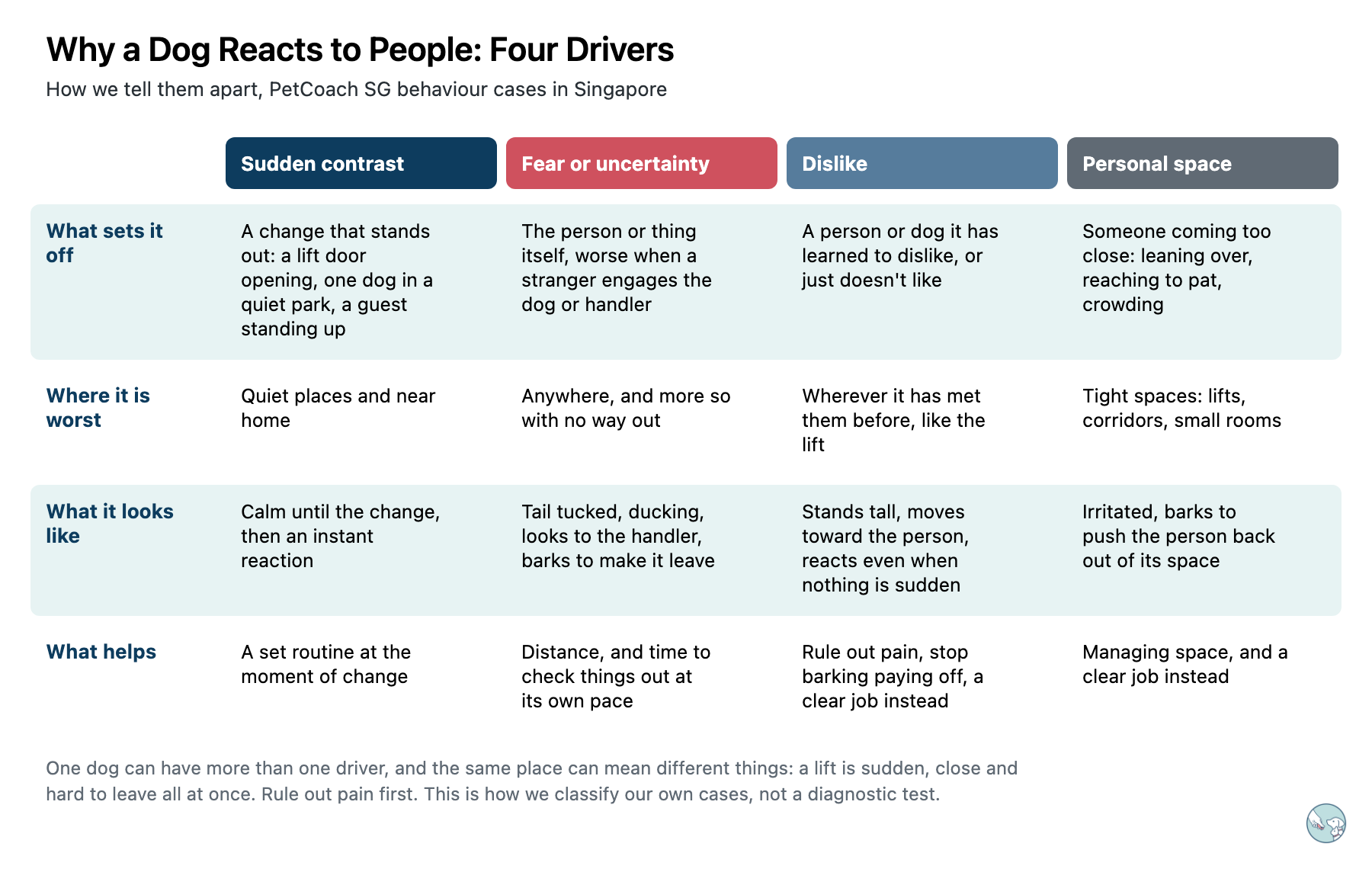
The same lunge at a lift door can come from different places, and the plan depends on which one it is. When a dog reacts to people, we look at what sets it off, where it happens and what the dog does before and after.
When It’s Fear
The setting alone doesn’t tell you the cause. One Border Collie came to us with reactions in lifts and tight corners, which looked like sudden contrast on paper. In person, she tucked her tail and ducked when someone moved quickly near her. Lifts and corners are also places with no way out, and her reactions fit fear better. A cornered dog can react defensively, which our guide to aggression in dogs covers.
Her earlier bad experiences had spread to strangers in general, and what she felt was closer to uncertainty than panic.
At first, even strangers walking past were a problem. Now a stranger who ignores her is fine, but one who stops to chat with her handler makes her nervous. She looks to her handler for reassurance, and then she barks. Left to herself, she walks up to a stranger to check them out, then ducks if they move fast. She takes treats near strangers, but eating helps her cope in the moment without changing how she feels about the person.
When It’s Dislike
Some dogs aren’t afraid at all. They just don’t like strangers close to them. Part of that can be the individual dog, since every dog has its own likes and dislikes.
Sudden contrast can also build it. A lift door opening on a stranger is an unpleasant jolt, and when that happens again and again, the dog links strangers in the lift with that feeling. It isn’t scared of them, but it has learned to dislike them and wants them gone. Barking works every time, because the person always gets out at their floor, so the habit grows.
A dog that dislikes the person usually stands tall and moves toward them, with no tucked tail or ducking. Once the dislike is learned, it may react even when nothing sudden happens, like a stranger already standing quietly in the lift. Before we settle on dislike, we rule out pain. A sore dog can find people crowding it hard to tolerate, and that’s a job for the vet first.
Personal Space
Some dogs react when a person comes into their personal space by leaning over them, reaching to pat them or standing too close in a lift or corridor. Nothing sudden has to happen, and a person can walk up slowly and calmly and still set the dog off. What the dog feels is usually closer to irritation than fear, and it barks to push the person back out. When the person steps away, the barking has worked.
This is related to sudden contrast, but it’s a separate trigger. Sudden contrast is about a change the dog didn’t expect. Personal space is about how close someone comes. In Singapore the two often arrive together, since a lift door opening on a stranger is sudden and close at the same time.
More Than One Driver
One dog can have several drivers at once. In another Border Collie, sudden contrast drove her reactions to people approaching or walking behind her, while bikes and cars raised her arousal through prey drive. A hard start in life, with months spent confined, meant almost everything was new to her.
This matters because the work differs. A fearful or uncertain dog needs distance and a slow build of confidence, often by letting it gather information at its own pace. A dog reacting to sudden contrast does better when the moment of change becomes predictable and it has a job to do in it.
A dog that dislikes the trigger, or is defending its space, also needs the barking to stop paying off, so management and a clear alternative job carry more of the work than a new association alone.
What We See in Our Cases
We went back through our behaviour cases in Singapore to see where sudden-contrast reactions happen, across every breed we work with.
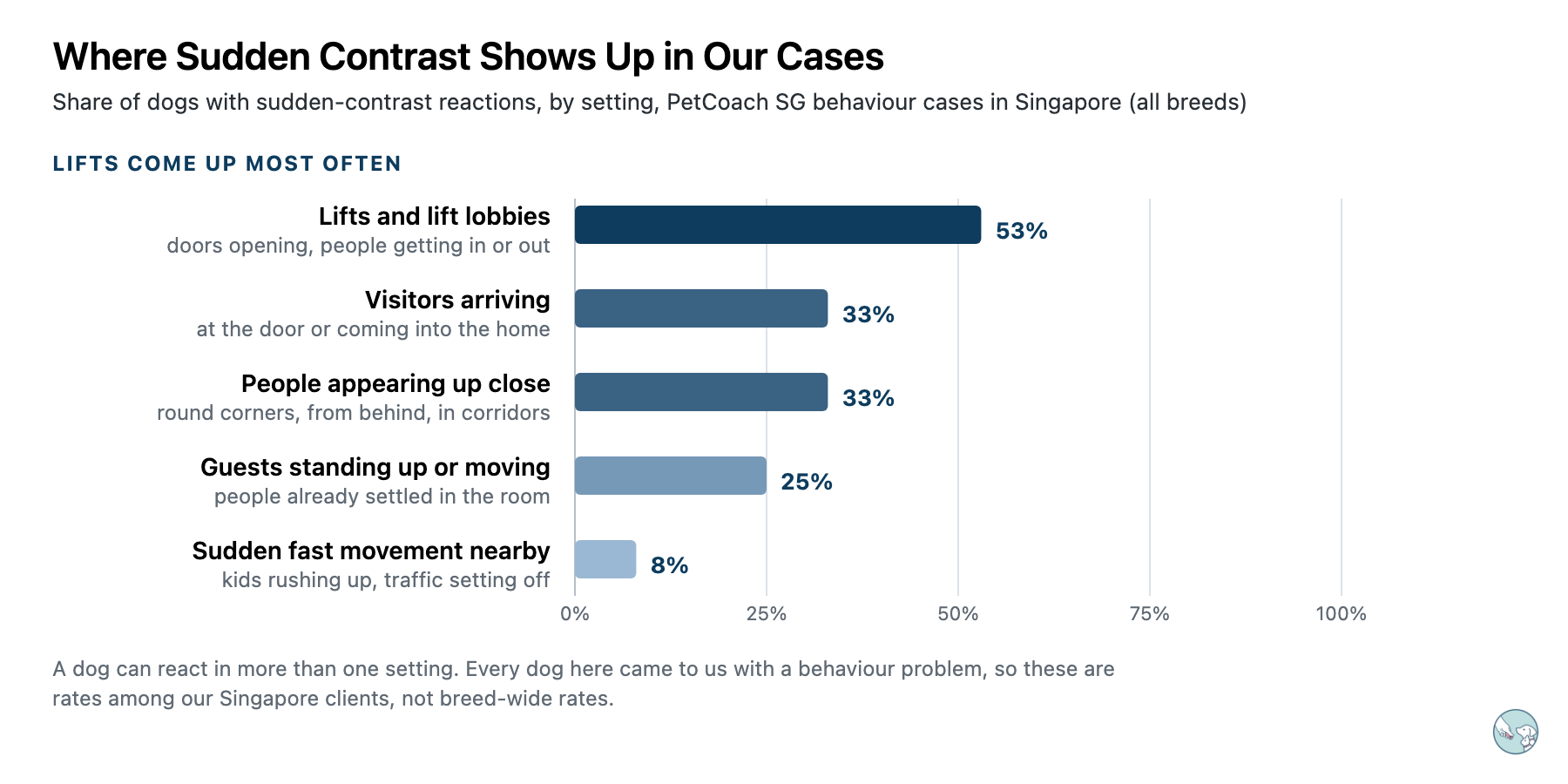
Lifts came up in more than half of these dogs, and visitors at home were close behind. A lot of this comes from Singapore living: small homes, shared lifts and corridors where people appear at close range all day.
Reacting to people and lifts was common in every group of dogs we see. What stood out in our Border Collies was the reason. Every one that reacted to people had a sudden-contrast element, and fear on its own was never the whole story. Local dogs showed the opposite: most of those who reacted to people were fearful, and sudden contrast was rare. Our guide covers that comparison in lifts, corners and sudden change.
The notes on our Border Collies show a consistent picture.
- Where it happens: lifts most often, then narrow corridors, B1 lobbies and carparks, people walking up from behind, and guests in the house.
- When it starts: where we know the onset, it began before about nine months to around a year. One puppy was already locking on to things that popped into view before any reactivity started.
- What came before: some of these dogs had been trained with harsh tools before they came to us, such as a prong collar or jabs to the chest. None of the notes record that helping.
How Sudden Change Spreads
Sudden-contrast reactions rarely stay with one trigger. A dog notices a neighbour’s new motorbike parked outside the block and starts reacting to it. Within weeks it reacts to every motorbike, then to bicycles and scooters as well. Border Collies seem to connect one bad moment to a whole group of similar things very fast, and in our cases this is how a single trigger most often turns into many.
Repetition widens the zone too. In one session, two children circled a Border Collie again and again on scooters. Her reaction distance grew from about 6 to 8 metres to 10 to 15 metres before the session ended.
Triggers also stack. A dog that has just come out of a crowded lift, walked a narrow corridor and passed a delivery rider is already keyed up. When a stranger appears at the next corner, the reaction looks out of all proportion, because it’s carrying everything that came before.
How We Train for Sudden Change
This is what we’ve done and what has worked for us, built around the dog in front of us. The aim is to make the moment of change predictable and to give the dog something to do in it.
Fewer Surprises
While training gets going, we cut down on surprises. That can mean waiting for an empty lift, stepping aside so others get out first, giving corners a wide berth and asking guests to move slowly. Every reaction that works for the dog makes the next one more likely, so management carries the early weeks.
Timing does a lot of this work. We plan walks for the times the dog’s triggers are least likely. If motorbikes set the dog off, we walk when traffic is lighter. If it’s other dogs, we pick the hours when neighbours don’t usually walk theirs.
Some dogs react less when someone else holds the leash, but we keep the main handler walking the dog. The handler needs the practice too, both in handling the dog and in leash skills, and those are the skills that carry the plan once training moves outside.
A Routine for Lifts
This is the routine one of our Border Collies worked through over several sessions.
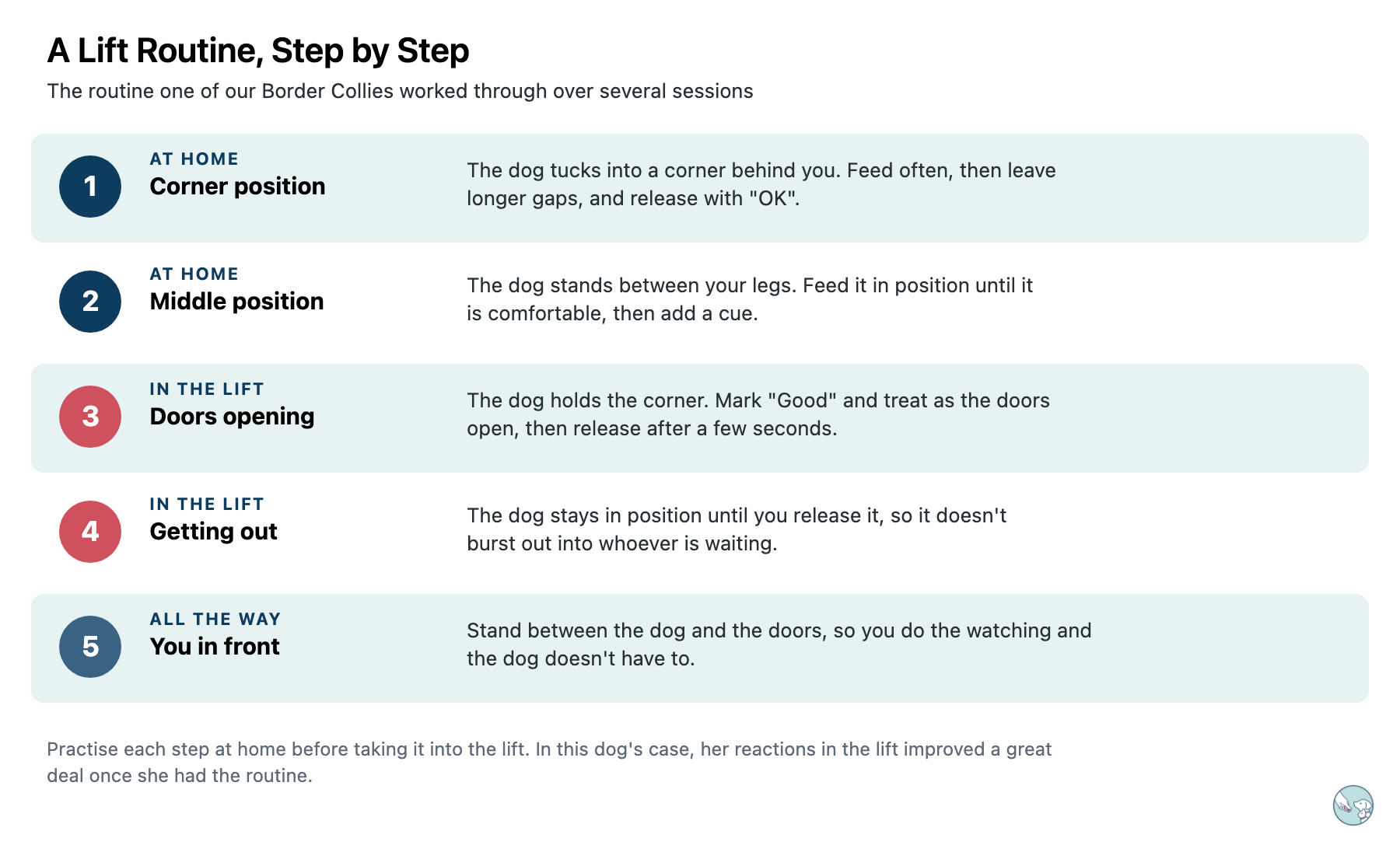
- A corner position at home. The dog learns to tuck into a corner behind you. Feed it there continuously at first, then leave longer gaps between treats, and release with “OK”.
- A middle position. As a second option, the dog stands between your legs. Feed it in position until it’s comfortable before adding a cue.
- Into the lift. The dog holds the corner. Mark with “Good” and treat as the doors open, then release after a few seconds.
- Getting out. The dog stays in position until you release it, so it doesn’t burst out into whoever is waiting.
- Your body in front. You stand between the dog and the doors, so the dog doesn’t have to watch them.
Once she had this routine, her reactions in the lift improved a great deal. Our guide to reactive dog training techniques explains the corner and middle positions, and why your body position helps.
Doorways and Corners
For another Border Collie, the hardest moments were the step from an open space into a narrow one, like walking into a corridor. We practised at home first.
- Walk through a doorway and click as the dog goes through. The dog turns back to you, and you treat.
- Pause, then do the same coming back.
- Start where no one is around, then use different doorways and places so the habit travels.
- At the entrance to a corridor, ask for a look up at you, mark it, then take a few steps in.
His aggression at those transitions stopped by the third session.
Visitors at Home
Guests standing up or moving around set off a quarter of the sudden-contrast dogs in our cases. We start with a mat the dog settles on, then add the things that usually set it off, like people walking around and the door opening. Guests help by moving slowly and predictably. Over time, we pair a guest standing up with something good, so the change predicts a treat. Our guide to counterconditioning explains how that pairing works.
Taking Over the Watch
Every routine above does the same thing underneath. The dog has been doing a watching job nobody asked it to do. You take that job over by choosing the position, standing between the dog and the change, and deciding when to move.
A herding dog given a clear role and a predictable order of events usually finds it much easier to stay calm. A reliable position cue makes all of this possible, which is one reason obedience training matters for reactive dogs.
Taking It Outdoors
Outdoors, we start far enough away that the dog can still think. When it looks at a person, we mark the look, the dog turns back to us, and it gets a treat. Over sessions we move closer. As the dog improves, we stop prompting. When it glances at a person and then turns back to us by itself, that choice gets the reward, and the dog learns that staying calm is something it can decide to do.
For a very keyed-up dog, rewarding the look can mean more checking, so we match the exercise to the dog rather than running the same plan for everyone.
Sudden Change in Singapore Homes
Singapore living packs sudden contrast into every day. Lift doors open straight onto people, B1 carparks echo, corridors turn blind corners, and neighbours and delivery riders pass at arm’s length. Inside, helpers, family and guests move around in small spaces.
Most Border Collies here live in condos or landed homes, since the breed isn’t on HDB’s approved list, which our guide covers under HDB rules. Condo lifts and lobbies are part of most walks, so lift and doorway routines are worth building early.
For some dogs, the lift means something else entirely. A dog with separation anxiety can learn that the sound of the lift means you’re leaving, which our article on Singapore-specific triggers explains. That needs a different plan from a dog that reacts to the people inside the lift.
Frequently Asked Questions
Why does my dog bark when the lift door opens?
Often it’s sudden contrast. The door opens on someone who wasn’t there a second ago, at close range, in a space the dog can’t leave. For some dogs, that lack of escape means fear is part of it too. A set lift routine and your body between the dog and the door help with both.
Why does my dog react when guests stand up?
The guest was already part of the dog’s picture of the room. Standing up is the change. A mat routine, guests who move slowly, and pairing a guest standing with a treat all help the dog cope with that moment.
Should I just take the stairs?
On a bad day, the stairs are fine as management. In a high-rise, though, the lift is part of daily life, so we build a lift routine alongside any short-term avoidance.
Is sudden contrast the same as fear?
No. A fearful dog is worried about the person or thing itself, and does better with distance and a slow build of confidence. A dog reacting to sudden contrast is set off by the change, and does better with a predictable routine at that moment. One dog can have both.
Can I prevent it in a Border Collie puppy?
Calm, positive experiences with lifts, doorways and people moving around make a good start. When a puppy notices something new and turns back to you, reward it. A puppy that stares hard at things popping into view is worth gentle work early, before that stare turns into barking. Our private puppy sessions cover this kind of groundwork.
Will my dog grow out of it?
In our cases, it started in adolescence and didn’t fade on its own. It improved with management and routines at the moments that set the dog off.
Why is my dog fine in malls but not at the park?
In a busy mall, nothing stands out, because everything is moving. In a quiet park, one person or dog is the only change, and that’s what the dog reacts to. It’s a common pattern in dogs that react to sudden contrast.
Help for Your Border Collie
For the other patterns we see in Border Collies here, see our guide to Border Collie training in Singapore. If your dog reacts at lifts, doorways or when guests move, our behaviour consults start by working out what’s driving it, then build routines around your home and your daily walks.
Sources
- MacLean, E. L. et al. (2019). Highly heritable and functionally relevant breed differences in dog behaviour. Proceedings of the Royal Society B. doi:10.1098/rspb.2019.0716
- Salonen, M. et al. (2020). Prevalence, comorbidity, and breed differences in canine anxiety in 13,700 Finnish pet dogs. Scientific Reports, 10, 2962. PMC7058607
