
A Border Collie spots a bicycle at the far end of the park connector. It drops into a crouch, fixes its eyes on the bike and goes completely still. Then, without a sound, it lunges to the end of the leash. Most people who live with a Border Collie in Singapore have seen some version of this.
That crouch and stare is part of the predatory sequence, the hunting toolkit every dog inherits. Herding breeding tuned it in a very particular way in Border Collies. When we looked back at our cases for our guide to Border Collie training in Singapore, reacting to moving things was the clearest Border Collie pattern of all: nearly nine in ten of the Border Collies we’ve worked with did it. Knowing where the urge comes from changes how we train it, and it explains why a leash so often turns it into barking and lunging.
The Predatory Sequence
Every dog carries the same hunting sequence, inherited from its wild ancestors. The biologist Raymond Coppinger, who spent decades studying working dogs, described it as eight steps.
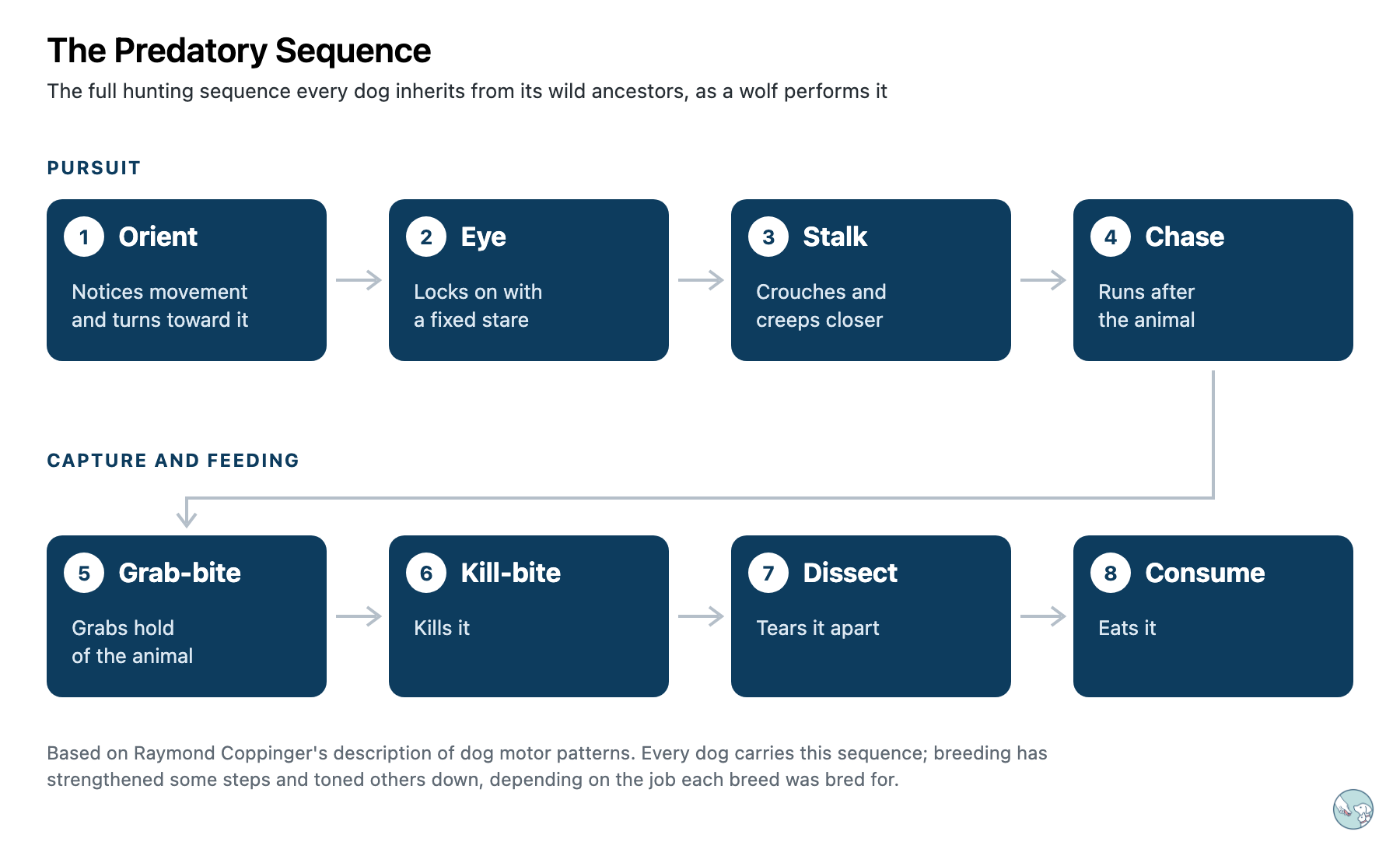
- Orient: the dog notices movement and turns toward it.
- Eye: it locks on with a fixed stare.
- Stalk: it crouches and creeps closer.
- Chase: it runs after the animal.
- Grab-bite: it grabs hold.
- Kill-bite: it kills the animal.
- Dissect: it tears it apart.
- Consume: it eats.
A wolf runs the whole sequence. Dogs carry the same steps, but breeding has strengthened some and toned others down to suit each breed’s job. Researchers who have filmed dogs hunting describe it in fewer, broader phases, so we treat the eight steps as a useful map of what a dog is doing at each moment. Individual dogs vary too, and some herding dogs still grab or nip.
What Herding Breeding Changed
A predator on the hunt makes its prey move, and moving sheep is exactly what a shepherd needs. The shepherd needed that movement without the kill, and needed a dog that would start and stop on a word. Generations of breeding for that job reshaped the sequence in three ways.
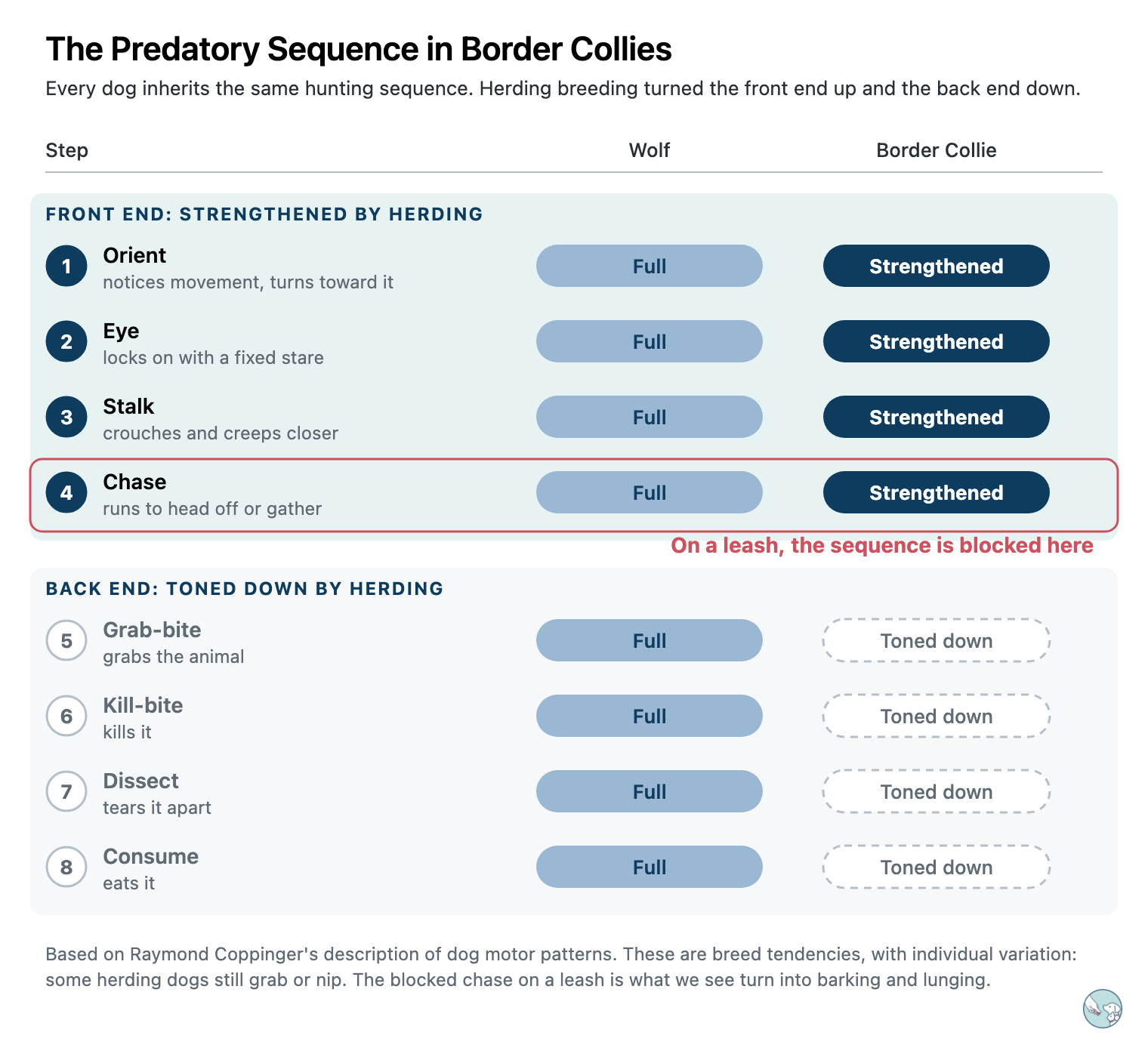
- The front end got stronger. Scanning, orienting, the fixed “eye” and the crouching stalk are all turned up. This is why Border Collies stare.
- The back end got weaker. The grab and kill bites are toned down, so the dog moves the sheep without catching them. In the Coppingers’ own description, Border Collies have strong links between eye, stalk and chase, and much weaker links to the bites.
- Stop and start came under control. The stop, go-round and lie-down that make Border Collies brilliant at herding and agility are the same control we use in training, and a big reason Border Collies excel in obedience.
Research on breed differences backs this up. A large study of breed behaviour found that predatory chasing is among the most strongly inherited differences between breeds. A 2025 genetics study went further and found a gene variant in working-line Border Collies linked to more stalking, chasing and grab-biting of toys.
A Finnish study of 13,700 dogs found that Border Collies had the highest rates of staring and of chasing lights and shadows among the 14 breeds it compared. The authors linked this to the breed’s history of herding by staring at livestock.
How Other Breeds Compare
Other breed groups carry the same eight steps, tuned for different jobs. Terriers were bred to catch and kill vermin and keep the sequence closest to a wolf’s. Pointers and retrievers keep the grab-bite to carry game, but a hard, crushing bite is a fault in them. Livestock guardians were bred to live among the flock, and most of the sequence is rare in them.
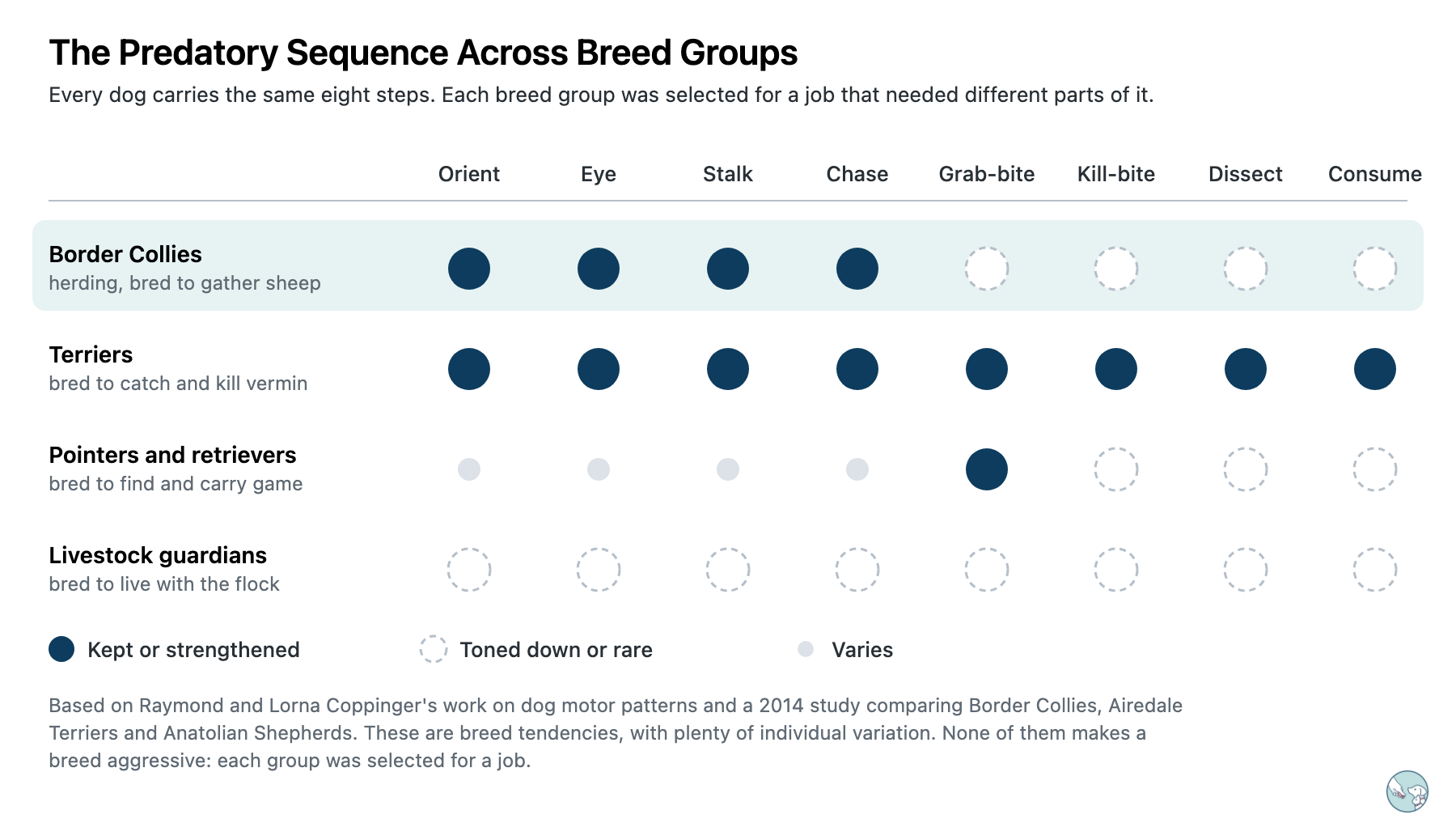
None of this makes any breed aggressive. Each group was selected for a job, and each one’s version of the sequence fits that job. In our own cases, other herding breeds such as Australian Shepherds and Shelties sat about halfway between Border Collies and everyone else when it came to reacting to moving things.
When the Chase Is Blocked
On a walk, the sequence starts the moment a bike appears. The dog orients, eyes and stalks, and then the leash stops it at the chase. The sequence is wired in and the dog is driven to finish it, so being stopped partway leaves it frustrated. With nowhere else to go, that energy comes out as barking, lunging or spinning.
The reaction gets stronger every time it happens, through two routes. A dog can have both.
- Frustration. For a dog that’s already frustrated, the lunge and the bark release the build-up, so the reaction feels good in itself. Pursuit is rewarding for dogs even when nothing gets caught. What the dog is missing is a way to cope: another behaviour it can put that energy into when it reaches that state.
- Controlling movement. Some Border Collies also carry fear, uncertainty or a strong need to control movement. When they bark or lunge, the bike, scooter or jogger moves away. From the dog’s side, its reaction made the trigger leave, and it works every time, because the trigger was always going to leave.
Either way, the reaction pays off, and each rehearsal lowers the threshold for the next one. Our guide to why reactive dogs escalate explains how this reinforcement builds over time.
The urge to chase is normal Border Collie behaviour. It turns into a reactivity problem when it’s blocked and rehearsed over and over, the same pattern we describe in breed instinct and reactivity. A Border Collie with no outlet at all often finds its own: staring, chasing lights and shadows, or other repetitive habits, which fits what the Finnish study found.
What We See in Our Cases
We went back through our behaviour cases in Singapore to see how reacting to moving things shows up in Border Collies specifically.
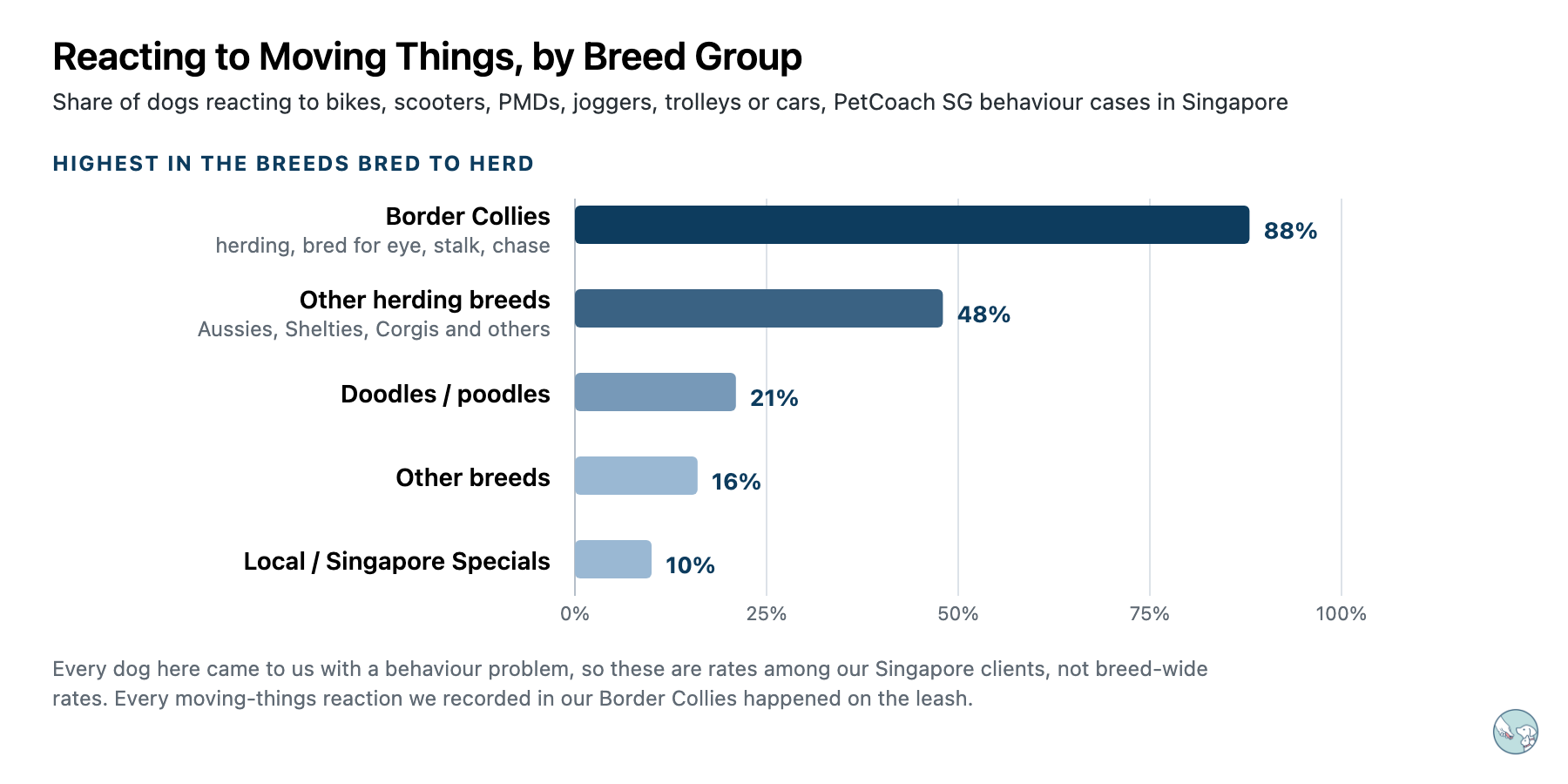
Reacting to moving things was highest in the breeds bred to herd. Every dog in this comparison came to us with a behaviour problem, so these figures describe our own clients. Local dogs carry the full predatory sequence too, yet they reacted least, so breeding is only part of the story.
The notes show a consistent picture.
- Triggers: bicycles, motorcycles, scooters and PMDs, trolleys, buggies, joggers, cars and birds.
- Often silent: an eye, a freeze, then a lunge without a bark. Owners are often caught off guard, because they’re listening for barking.
- Always on the leash: every movement reaction we recorded in our Border Collies happened on the leash.
- Starts in adolescence: where we know the onset, it began somewhere between six and twelve months. One owner described a “perfect puppy” until about six or seven months. The earliest sign we’ve seen was a puppy fixating on things that suddenly appeared.
Several of these dogs had been trained with harsh tools before they came to us, and none of the notes record that helping.
Prey Drive Lookalikes
A Border Collie lunging at a bike isn’t always showing prey drive, and the right plan depends on the reason. We see three patterns in our cases.
- Prey drive. The dog reacts to moving things at a distance, anywhere, often silently. This is the most common pattern.
- Fear. The reaction is about making the trigger go away. A dog that’s wary of bikes may bark and lunge to drive one off. When the bike moves on, the dog feels relief, and that relief rewards the reaction, so it comes back stronger next time. Stress makes it more likely, for example after an attack by another dog or harsh handling.
- Sudden change. Near home, where the dog knows exactly what’s normal, something new stands out, like a neighbour’s new motorbike. We call this sudden environmental contrast. The dog starts reacting to that one bike, then to every motorbike, and then to bicycles and scooters too. In our experience, Border Collies make these links quickly, and it’s one of the most common ways we see reactivity spread. Our guide covers sudden change in lifts, corners and sudden change.
Some dogs show more than one at once. In one Border Collie, prey drive raised her arousal around traffic, while sudden change drove her reactions to people. A fearful dog needs distance and a slow build of confidence. A prey-driven dog needs an outlet and control.
How We Train Prey Drive
The wish to chase is inherited and rewarding in itself, so we don’t expect to train it away. We can change how a dog feels when a bike goes past, and we can give it something else to do. We can’t remove the wish to chase. Every plan we build draws on the same pieces below, and which ones lead depends on the dog in front of us.
Management First
Every lunge that works makes the habit stronger, so the early weeks rely on management. We plan walk routes and times away from busy park connectors and delivery peaks, keep enough distance for the dog to stay thinking, and turn away early when a trigger appears.
A Legal Outlet
A Border Collie that can’t chase anything will look for something to chase, so we give the drive a planned outlet in a game with us. It’s crucial to note that an outlet only helps when two things are true. The dog has to complete the sequence it needs, which for a Border Collie means eyeing, stalking and chasing the toy and then catching it. And we have to control it, so the game starts and ends on our cue. Uncontrolled repetition, like endless ball throwing or a flirt pole the dog can chase whenever it likes, is just more rehearsal of the chase and makes prey drive stronger.
Tug, fetch and a flirt pole give the dog the whole sequence: eye, stalk, chase, grab and a release. Rules turn the game into training. The dog waits, chases on a cue and drops on a cue. Our guide to tug and fetch in training shows how to build these rules.
The same games build impulse control. When the dog sees the toy, it holds back while we ask for a different behaviour, such as a sit or a down, and then we release it to the toy as the reward. The dog learns that its own behaviour is what gets it the toy. That gives it agency: things aren’t just happening to it, and it can work within our rules to get what it wants. Our guide to why obedience training matters explains how this kind of structure builds trust instead of taking choices away.
Scent work suits the search-and-orient end of the sequence. With a flirt pole, we keep sessions short, play on good footing and stick to the cooler times of day. The flirt pole is a newer addition to our plans than tug, and it’s part of how we work now.
Something Clear to Do
The core of the plan is a clear, rewarded job that replaces the lunge. “Look at that” is an operant behaviour with counterconditioning built in: the dog notices the bike, turns back to us, and that turn earns the reward. The dog has something to do with its energy, and the bike starts to predict good things. With one Border Collie, “look at that” and a simple back-and-forth pattern game largely settled her car reactions.
“Let’s go” is a stronger operant option. On cue, the dog turns and moves with us, and we pay it on the move. Moving away is easier than standing still for a keyed-up dog, and it gives the chase energy somewhere to go. Paying with a thrown treat or toy to chase adds even more value.
Timing matters. We cue the alternative before the dog locks on, while it can still think. Cueing it after a lunge can teach the dog a chain of lunge, stop, reward, and Border Collies learn chains quickly. Our guide to reactive dog training techniques explains these exercises in more detail.
The Dog in Front of Us
One plan doesn’t fit every Border Collie. A young, hypervigilant Border Collie we worked with couldn’t do “look at that” at all. He fixated on the trigger and couldn’t look back. So we stepped back to management, more distance and simple pattern games at home and in quiet spots, then brought in “let’s go” as his way out. If one exercise isn’t working, that tells us about the dog’s state, and there’s still plenty we can do to help.
Bringing It Outside
We build up exposure gradually, starting far enough away that the dog can still think, then moving closer over several sessions. Later, we wait for the dog to look away or check in on its own, mark it and pay with a toy chase. The dog learns that its own calm choice gets it what it wants. Off the leash, we never trust a recall near roads or bike paths, and in Singapore dogs need to be on a leash in public places anyway.
Long-Term Living
For dogs whose chase is strongest, especially the silent “eye then lunge” dogs, some management stays for life. Veterinary behaviourists note that true predatory behaviour is unlikely to be fully cured. Training still makes life easier. The dog gains more ways to cope, and the handler gains more ways to get through a busy path calmly. We may never remove the urge, but we can give dog and handler enough skills to live safely and comfortably in a busy city.
Prey Drive in Singapore
Singapore is full of things that move fast. Park connectors are shared with cyclists and PMDs, food-delivery riders use the footpaths, and supermarket trolleys, condo buggies and birds at void decks and hawker centres add to the list. Border Collies here live in condos and landed homes, so condo driveways, buggies and residents jogging round the estate are everyday triggers.
Timing helps a lot. Early morning and late evening walks avoid both the heat and the busiest delivery traffic, which gives a prey-driven dog fewer triggers to practise on.
Frequently Asked Questions
Can you train prey drive out of a dog?
No. Prey drive is inherited and rewarding in itself. What training can do is change how the dog feels when a trigger goes past, give it a clear job to do instead, and make life with the drive safe and easy for dog and owner.
Is prey drive the same as aggression?
No. They come from different motivations. A dog chasing a bike is running a hunting sequence, while aggression usually comes from fear or frustration. The two can look similar on a leash, which is why the reason behind the reaction shapes the plan.
Why does my Border Collie stare?
That stare is “the eye”, the part of the predatory sequence herding breeding strengthened most. It’s normal Border Collie behaviour. It becomes a problem when the dog fixates and can’t look away, or stares at lights, shadows or the same spot for long periods.
When does prey drive start in puppies?
In our cases, reacting to moving things usually started in adolescence, between six and twelve months. Fixation can show earlier: the youngest dog we’ve seen with it was a puppy who locked onto things that suddenly appeared.
Is a flirt pole good for Border Collies?
Yes, with rules. The dog should wait, chase on cue, catch the lure and drop it on cue. Keep sessions short, play on good footing and avoid the hottest part of the day. Uncontrolled flirt pole play rehearses the chase and can make prey drive stronger.
Should I let my dog chase birds?
We’d avoid it. Every chase rehearses the pattern and makes the next one more likely. A planned chase with a toy in a game with you gives the drive an outlet you can control.
Help for Your Border Collie
For the other patterns we see in Border Collies here, see our guide to Border Collie training in Singapore. If your dog is lunging at bikes or scooters, our behaviour consults start by working out what’s driving the reaction, then build a plan around your dog and your daily walks.
Sources
- Coppinger, R. & Coppinger, L. (1996). Biologic bases of behavior of domestic dog breeds. In V. L. Voith & P. L. Borchelt (Eds.), Readings in Companion Animal Behavior (pp. 9–18). Veterinary Learning Systems. Reprint
- Coppinger, R. & Feinstein, M. (2015). How Dogs Work. University of Chicago Press.
- MacLean, E. L. et al. (2019). Highly heritable and functionally relevant breed differences in dog behaviour. Proceedings of the Royal Society B. doi:10.1098/rspb.2019.0716
- Jeong, H., Ostrander, E. A. & Kim, J. (2025). Genomic evidence for behavioral adaptation of herding dogs. Science Advances, 11(18). doi:10.1126/sciadv.adp4591
- Salonen, M. et al. (2020). Prevalence, comorbidity, and breed differences in canine anxiety in 13,700 Finnish pet dogs. Scientific Reports, 10, 2962. PMC7058607
- Udell, M. A. R., Ewald, M., Dorey, N. R. & Wynne, C. D. L. (2014). Exploring breed differences in dogs (Canis familiaris): does exaggeration or inhibition of predatory response predict performance on human-guided tasks? Animal Behaviour, 89, 99–105. doi:10.1016/j.anbehav.2013.12.012
- Lindell, E., Horwitz, D. & Landsberg, G. Dog behavior problems: aggression towards unfamiliar dogs, part 2: treatment. VCA Animal Hospitals. VCA
