
At the 2025 FCI Obedience World Championship in Norway, 99 of the 120 dogs in the top class were Border Collies, and so were 18 of the 20 dogs in the final. Border Collie obedience has a reputation for good reason: walk into almost any obedience ring and the breed is everywhere.
No study has crowned Border Collies the best obedience breed. Research does point to a set of traits that sheepdog work shaped and the obedience ring rewards. This article looks at what those traits are and where they come from. If you’re here for help with your own dog, our guide to Border Collie training in Singapore is the place to start.
Border Collies in the Ring
The pattern holds at every level of the sport. At the world championship, Border Collies filled the final.
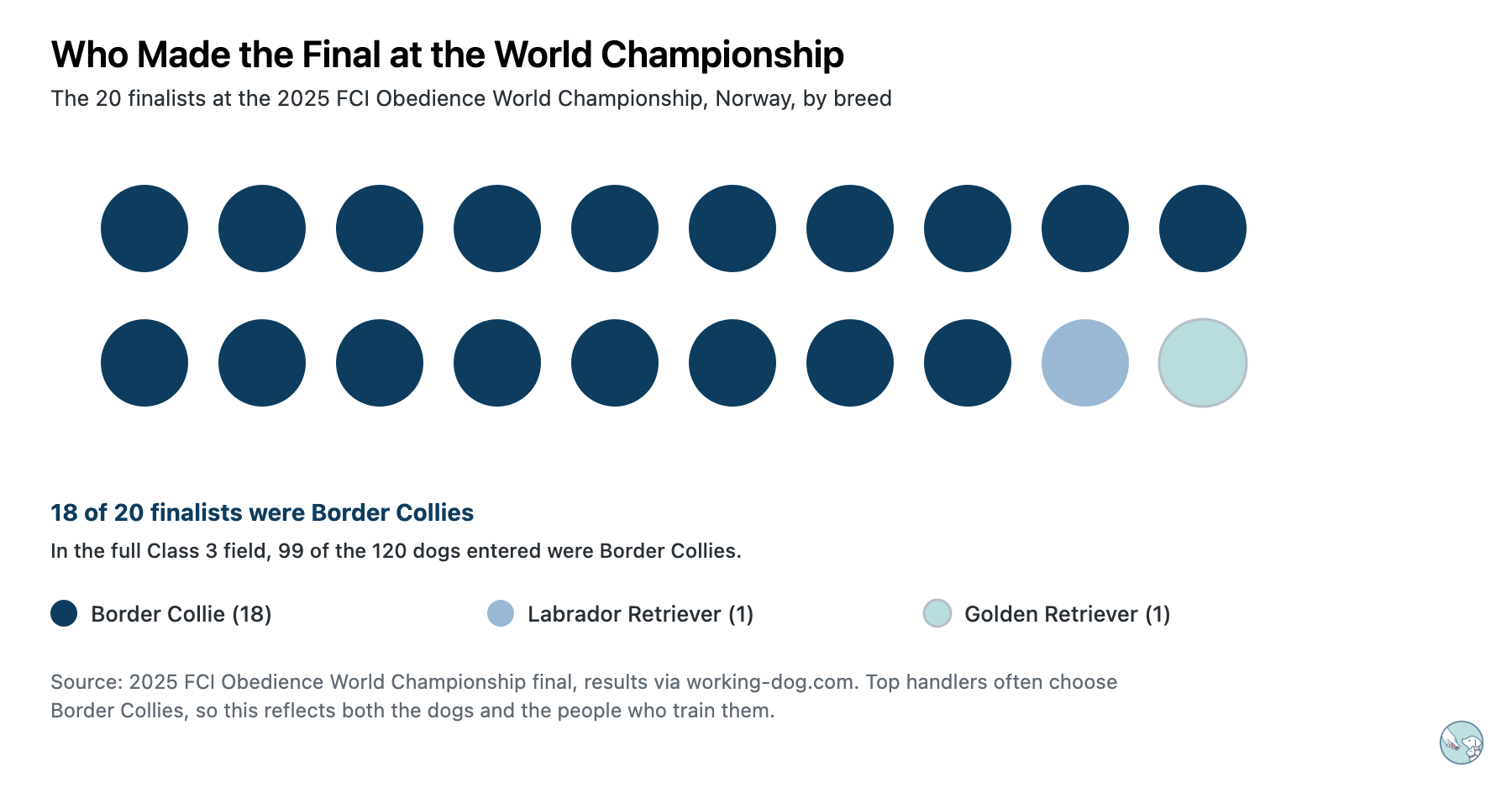
At Crufts, Border Collies won the top obedience prizes in 2016, 2020 and every year from 2022 to 2025. The world championship is run in FCI Class 3, the hardest class in the international system, and our guides to Crufts obedience and AKC obedience cover how the other major formats work.
Most top handlers choose Border Collies because the breed is so well suited to close, cue-by-cue work with a person, and that’s exactly what obedience scores. Studies of breed differences back this up. Responsiveness to a handler’s direction is one of the few behaviours where breed ancestry makes a clear difference, and Border Collie ancestry is linked to it. How easily a dog learns from people is also among the most strongly inherited differences between breeds. The rest of this article looks at why.
Handler choice and the dogs themselves both play a part. At the 2025 championship, Border Collies made up 83% of the top class and 90% of the final, so they did slightly better than their share of the entries. Other breeds win at the highest level too. A Golden Retriever won the 2025 AKC Obedience Classic, and an Australian Shepherd won the 2025 Westminster Masters Obedience Championship.
What the Obedience Ring Rewards
Obedience scores a dog on precise work with its handler, which is why the breed fits it so well. Each exercise asks for a slightly different strength.
- Heelwork and position changes: the dog has to watch the handler closely and match every turn and change of pace.
- Distance work: send-aways and positions given from across the ring mean taking cues from far away.
- Stays and recalls: the dog holds still with plenty of energy in reserve, then moves fast on a single cue.
Judges also score the team as a whole. In FCI obedience, “General Impression” rewards a dog that clearly wants to work and a team that enjoys it. Our guide to dog obedience explains how competitive obedience differs from everyday manners, and rally obedience is the more relaxed ring sport built on the same skills.
Bred to Work With People
Border Collies aren’t alone here. Breeds developed to work alongside a handler, such as sheepdogs, retrievers and pointers, share a set of social skills that independent working breeds tend to lack.
When researchers compared breeds bred to work in eye contact with a handler against breeds bred to work on their own, the cooperative workers were better at following a person’s pointing gesture, and also outperformed mixed breeds. A second study found working breeds read human gestures better than basenjis and toy poodles, even though every breed could follow cues to some degree.
Learning by Watching
A 2024 study from Budapest shows what this looks like in practice. Researchers placed each dog’s favourite treat or toy behind a see-through V-shaped fence. The dog could see the reward but couldn’t reach it by going straight ahead. It had to walk around the end of the fence.
Each dog first had a minute to solve it alone. Then, while the dog watched, a researcher walked around the fence to the reward and back, talking to the dog as she went. Dogs from cooperative breeds, such as herders, retrievers, pointers and setters, got faster at reaching the reward after watching her. Dogs from independent breeds, such as terriers, hounds and Shiba Inus, didn’t improve. The cooperative dogs also spent more of the demonstration looking at the person.
Border Collies were the most common breed in the cooperative group. The experiment tested social learning in family dogs, and the skill it measured is the one obedience depends on: a dog that keeps watching its person, and learns from what they do, picks up the handler’s movement and timing.
Asking for Help
Given a task they couldn’t solve, herding dogs looked at their owners for longer than ancient breeds and solitary hunting breeds, and preferred their owner to a stranger. The evidence on gaze is mixed: another study linked it more to how closely a breed is related to wolves than to the job it was bred for. The strongest evidence is for following gestures and learning from people.
Where Border Collies Have an Edge
Sheepdogs, retrievers and pointers all pay close attention to people. Sheepdog work added a particular mix of traits on top of that. No single study proves Border Collies have an edge, but each of these points helps explain it.
Watching Movement
Border Collies were bred for an intense stare known as “the eye”, and they notice the smallest movement. In a study of three working breeds, Border Collies and Airedale Terriers followed a brief pointing gesture better than a livestock guardian breed, at least at first. The lead researcher linked this to a tendency to watch for movement and respond to it.
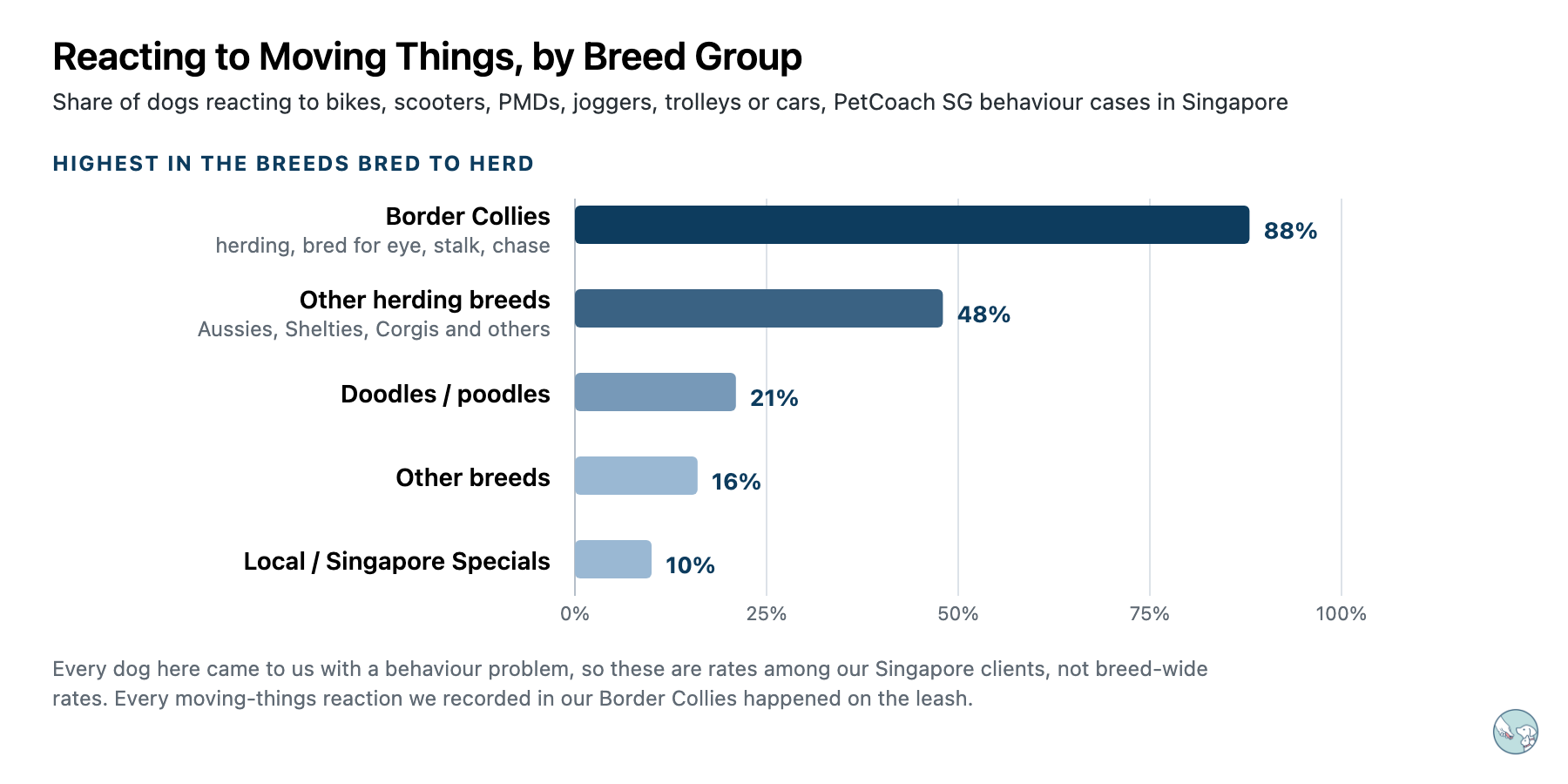
We see the same sensitivity from a different angle in our own behaviour cases. In the dogs that come to us in Singapore, nearly nine in ten Border Collies react to moving things, compared with about half of other herding breeds and about one in five other dogs. Our article on Border Collie prey drive explains where that comes from.
In the ring, that eye for movement turns into reading the handler: the drop of a shoulder before a turn, a change in footwork before a halt. Storm, the Australian Shepherd our obedience trainer Shafik trains, is another herding dog. Here he holds his focus on Shafik through a figure-of-8.
Drive Under Control
A sheepdog needs plenty of drive to run all day, and it needs to stop the instant it’s asked. Raymond and Lorna Coppinger described Border Collies as having strong links between eye, stalk and chase, with weaker links to the bite that can be shaped by the handler. Breeding kept the drive and made it controllable. A working sheepdog runs out, gathers and drives a flock at a distance, stopping and changing direction on its handler’s signals.
Obedience asks for the same combination. Shafik trains Storm for obedience, and Storm comes from show lines, which are usually bred less for working drive. His drive is still obvious. In Shafik’s experience, working-line dogs usually bring even more. In this clip, Storm watches a moving toy right in front of him and waits for the cue before he grabs it.
That drive is what makes play such a strong reward in obedience, as our guides to play-based rewards and tug explain. For high-drive dogs, obedience is also an outlet, which we cover in why obedience matters.
Learning Words and Cues
When researchers went looking for dogs that can learn the names of dozens of toys, more than half of the gifted word learners they found were Border Collies. The researchers stress that the talent is rare even within the breed.
The largest genetic study of dog behaviour so far found that responsiveness to direction, which researchers call biddability, is one of the few behaviours where breed ancestry makes a real difference. Border Collie ancestry was among those linked to it.
Bred for the Work
A 2025 genetics study found signs of selection in herding breeds in genes tied to social behaviour and thinking. In Border Collies, the adapted genes were linked to memory, learning new movements and social interaction.
Breeding records point the same way. Working registries such as the International Sheep Dog Society, running since 1906, keep stud books so breeders can choose dogs of known working ability or trial success. A dog without a registered pedigree can only join by proving itself on sheep, through trial placings or a herding test. One American working registry won’t register a dog on merit if the dog or its parents have been made show champions. In breeds split into working and show lines, show-bred dogs have scored lower for trainability than working-bred ones.
Breed Isn’t Destiny
It’s crucial to note that all of this describes Border Collies as a group, and it can’t predict how any one dog will do. Breed explains only about 9% of the differences in behaviour between individual dogs. Plenty of Border Collies never take to obedience, and plenty of other breeds excel at it.
The well-known ranking of Border Collies as the “smartest” breed came from a survey of obedience judges’ opinions, rather than from testing dogs. In the ring, results still come down to the individual dog, the handler’s skill and years of careful preparation. Our essential obedience steps show what that preparation looks like.
The Same Traits, Off the Field
The attention that wins in the ring has another side. A dog bred to notice every small movement also notices the bicycle at the end of the park connector, the lift door opening and the drilling next door. In our behaviour cases, Border Collies react to moving things far more often than other dogs, and many are sensitive to noise and sudden change.
Owners who understand both sides get the best from the breed. The same focus that makes a Border Collie easy to work with makes structure, routine and a job to do especially important in a busy city.
Obedience in Singapore
Singapore has its own obedience trials, run under the Singapore Kennel Club and by training schools with PETAS, with classes starting at Pre-Novice. Our guide to SKC obedience explains the classes and exercises.
Shafik runs our obedience group classes, built around the same exercises used in local trials. If you’d like to see what your own dog can do in the ring, our training programmes are a good place to start.
Frequently Asked Questions
Are Border Collies the smartest dog breed?
No test has shown that. The famous ranking came from a survey of obedience judges. Research does show that Border Collies are very responsive to people and learn cues quickly, and that these traits are partly inherited. Individual dogs vary a lot.
Why do Border Collies win obedience trials?
They were bred to work closely with a handler, watch small movements and keep high drive under control, which is what obedience rewards. Top handlers choose them for those reasons, so they also make up most of the entries at the highest level.
Do other breeds compete in obedience?
Yes. Golden Retrievers, Labradors, Belgian Shepherds, Australian Shepherds and Shelties all compete and win. A Golden Retriever won the 2025 AKC Obedience Classic, and an Australian Shepherd won the 2025 Westminster Masters Obedience Championship.
Are Border Collies good for obedience beginners?
They’re willing and quick to learn, which helps. Their sensitivity and drive can be a lot for a first dog, so start with a calm foundation and get help early if your dog struggles with movement or noise.
Help for Your Border Collie
If your Border Collie struggles with bikes, lifts or noise, our behaviour consults start by working out what’s driving the behaviour.
Sources
- Gácsi, M., McGreevy, P., Kara, E. & Miklósi, Á. (2009). Effects of selection for cooperation and attention in dogs. Behavioral and Brain Functions, 5, 31. PMC2731781
- Wobber, V., Hare, B., Koler-Matznick, J., Wrangham, R. & Tomasello, M. (2009). Breed differences in domestic dogs’ (Canis familiaris) comprehension of human communicative signals. Interaction Studies, 10(2), 206–224. PDF
- Dobos, P. & Pongrácz, P. (2024). You talkin’ to me? Functional breed selection may have fundamentally influenced dogs’ sensitivity to human verbal communicative cues. BMC Biology, 22, 183. doi:10.1186/s12915-024-01983-1
- Van Poucke, E., Höglin, A., Jensen, P. & Roth, L. S. V. (2022). Breed group differences in the unsolvable problem task: herding dogs prefer their owner, while solitary hunting dogs seek stranger proximity. Animal Cognition, 25(3), 597–603. PMC9107394
- Konno, A. et al. (2016). Dog breed differences in visual communication with humans. PLOS One. PMC5063391
- Udell, M. A. R., Ewald, M., Dorey, N. R. & Wynne, C. D. L. (2014). Exploring breed differences in dogs: does exaggeration or inhibition of predatory response predict performance on human-guided tasks? Animal Behaviour, 89, 99–105. doi:10.1016/j.anbehav.2013.12.012
- Coppinger, R. & Coppinger, L. (1996). Biologic bases of behavior of domestic dog breeds. In Readings in Companion Animal Behavior. Reprint
- Fugazza, C. et al. Gifted word learner dogs. Eötvös Loránd University. ELTE
- Morrill, K. et al. (2022). Ancestry-inclusive dog genomics challenges popular breed stereotypes. Science, 376, eabk0639. PMC9675396
- MacLean, E. L. et al. (2019). Highly heritable and functionally relevant breed differences in dog behaviour. Proceedings of the Royal Society B. doi:10.1098/rspb.2019.0716
- Jeong, H., Ostrander, E. A. & Kim, J. (2025). Genomic evidence for behavioral adaptation of herding dogs. Science Advances, 11(18). doi:10.1126/sciadv.adp4591
- Serpell, J. A. & Hsu, Y. (2005). Effects of breed, sex, and neuter status on trainability in dogs. Anthrozoös, 18(3). doi:10.2752/089279305785594135
- The Kennel Club. Crufts obedience champion press releases, 2016–2025. Crufts 2025
- 2025 FCI Obedience World Championship results. working-dog.com
- International Sheep Dog Society. Home; Registration on Merit
- American Border Collie Association. Register on Merit Program
- American Kennel Club. 2025 Obedience Classic; 2025 Westminster Masters Obedience
