
Two Border Collies can look like different breeds and act like different dogs. One may come from generations of dogs bred to work sheep. The other may come from dogs bred to match a written standard in the show ring. Both are Border Collies, but the goals behind their breeding have pulled them in different directions.
In Singapore, many owners don’t know which kind of Border Collie they have. Some dogs are part Border Collie and part something else entirely. Knowing where a dog comes from helps you plan for its energy and sensitivity before problems show up. If you’re still deciding whether the breed suits you, our guide to Border Collies in Singapore covers daily life, HDB rules and the problems we see most.
Two Lines From One Sheepdog
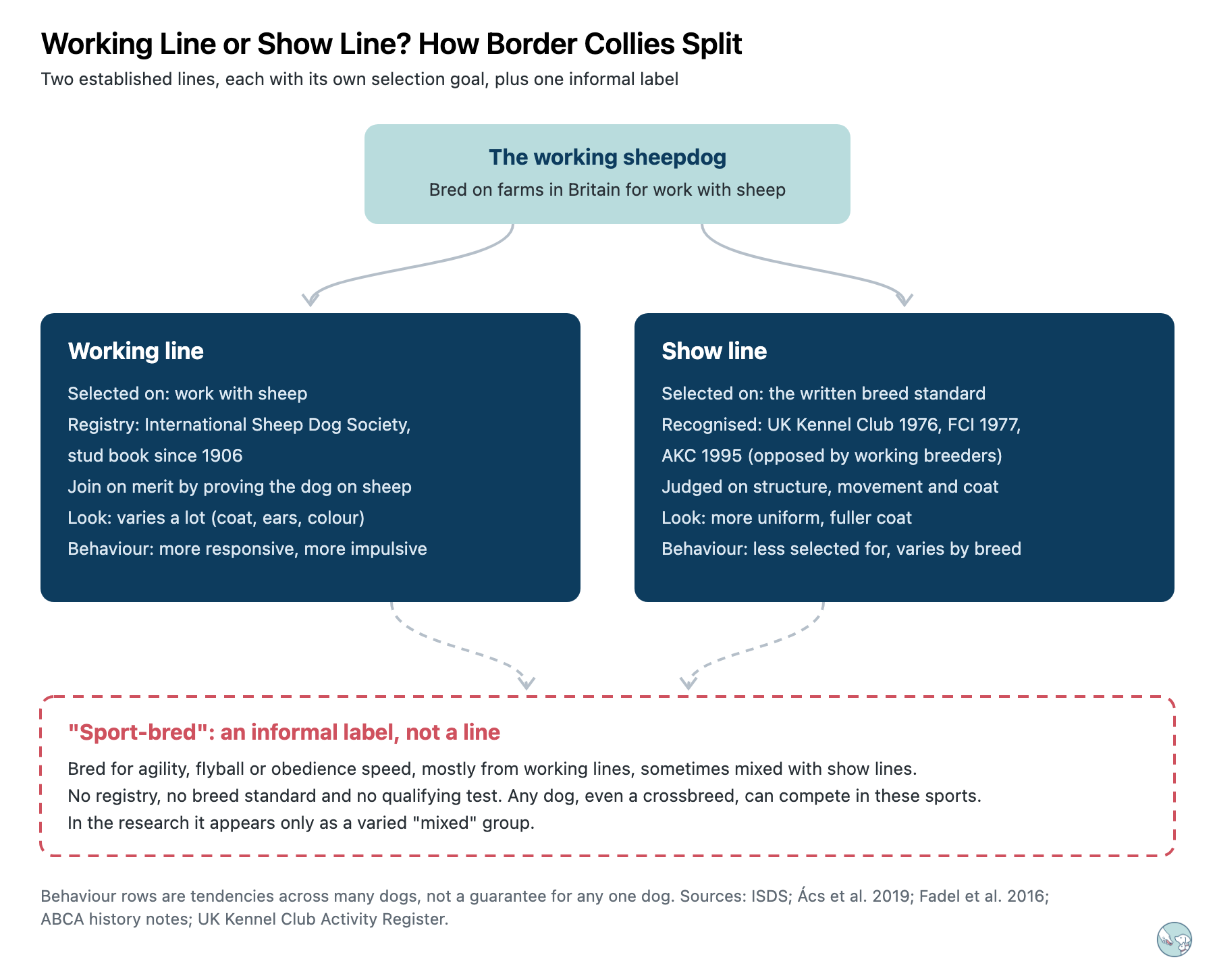
A line is a group of dogs bred over many generations for one goal. When two groups of the same breed are selected for different goals, they slowly drift apart in looks and behaviour. Border Collies split this way into working lines and show lines.
Working Lines
Working lines are bred to herd sheep. Breeders choose parents by what they do on the field: how well they read the sheep, keep their balance, and take direction from the shepherd. The International Sheep Dog Society has kept a stud book for working sheepdogs since 1906. A dog without registered parents can join by proving itself on sheep.
Because looks were never the goal, working Border Collies vary a lot. Some have short coats, some long. Ears can stand up or fold over, and colours range well beyond black and white. What they share is the drive to watch, gather and control movement, which you can see in how Border Collies herd sheep.
Show Lines
Show lines are bred to a written breed standard. Judges look at the dog’s structure, movement and coat in the show ring. The UK Kennel Club recognised the breed in 1976, and the international kennel federation, the FCI, followed in 1977. The American Kennel Club recognised it in 1995, against strong opposition from working breeders. They worried that breeding for looks would cost the breed its working ability.
Show Border Collies tend to look more alike, often with a fuller coat and the classic black-and-white pattern. They are still Border Collies, with the same family history and many of the same instincts.
Sport-Bred Dogs
You may also see breeders advertise “sport-bred” or “sport line” Border Collies, bred for agility, flyball or fast obedience, a sport where Border Collies dominate the ring. This is an informal label. There’s no sport-line registry, no breed standard for it, and no test a dog has to pass. Most sport-bred dogs come from working lines, sometimes mixed with show lines, and researchers who have studied the breed’s lines only describe them as a varied mixed group.
Sport doesn’t need any particular line. In the UK, any dog, even a crossbreed, can be registered to compete in agility, flyball, obedience and rally. The label still tells you something useful. When a sport keeps getting faster and harder, breeders tend to select for more and more intensity, and some end up with dogs that are harder to switch off than the working lines they came from. If a breeder describes a puppy as sport-bred, ask what that means for its drive and how easily its parents settle at home.
How Other Breeds Split
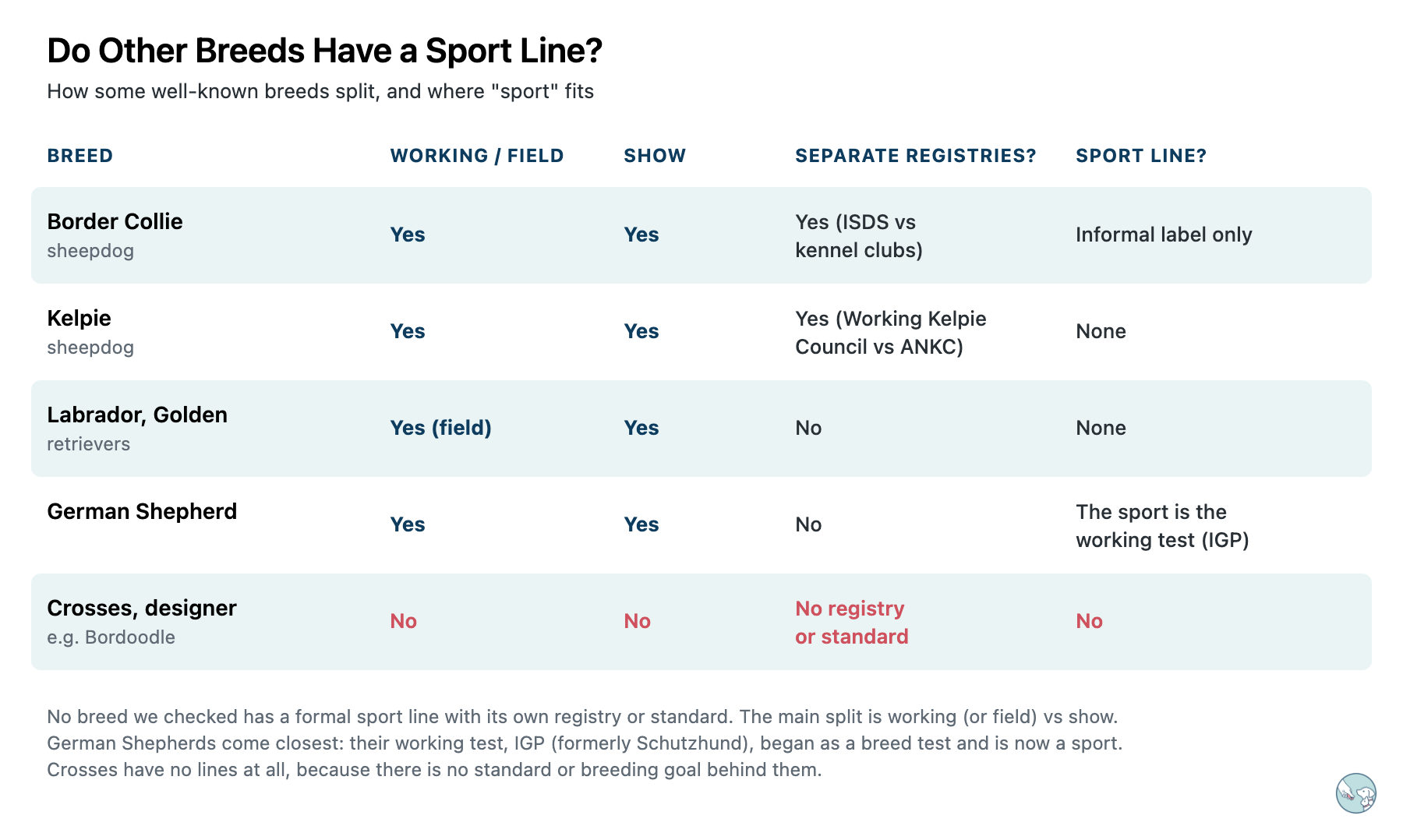
Many working breeds have split the same way, and none of the ones we looked at has a formal sport line. Some, like Border Collies and Kelpies, even keep separate registries for working and show dogs. Others, like Labradors and Golden Retrievers, have field and show lines within one registry. German Shepherds come closest to a sport line: their working test began as a check on breeding stock and is now a sport in its own right, so for them sport and work overlap.
Crosses and designer breeds have no lines at all, because there’s no standard and no breeding goal behind them.
Shafik’s Australian Shepherd, Storm, shows how loose the split can be. Storm comes from show lines, which are usually bred less for working drive, and his drive is still obvious. In this clip, he puts all of that energy into an obedience rep, working for his ball.
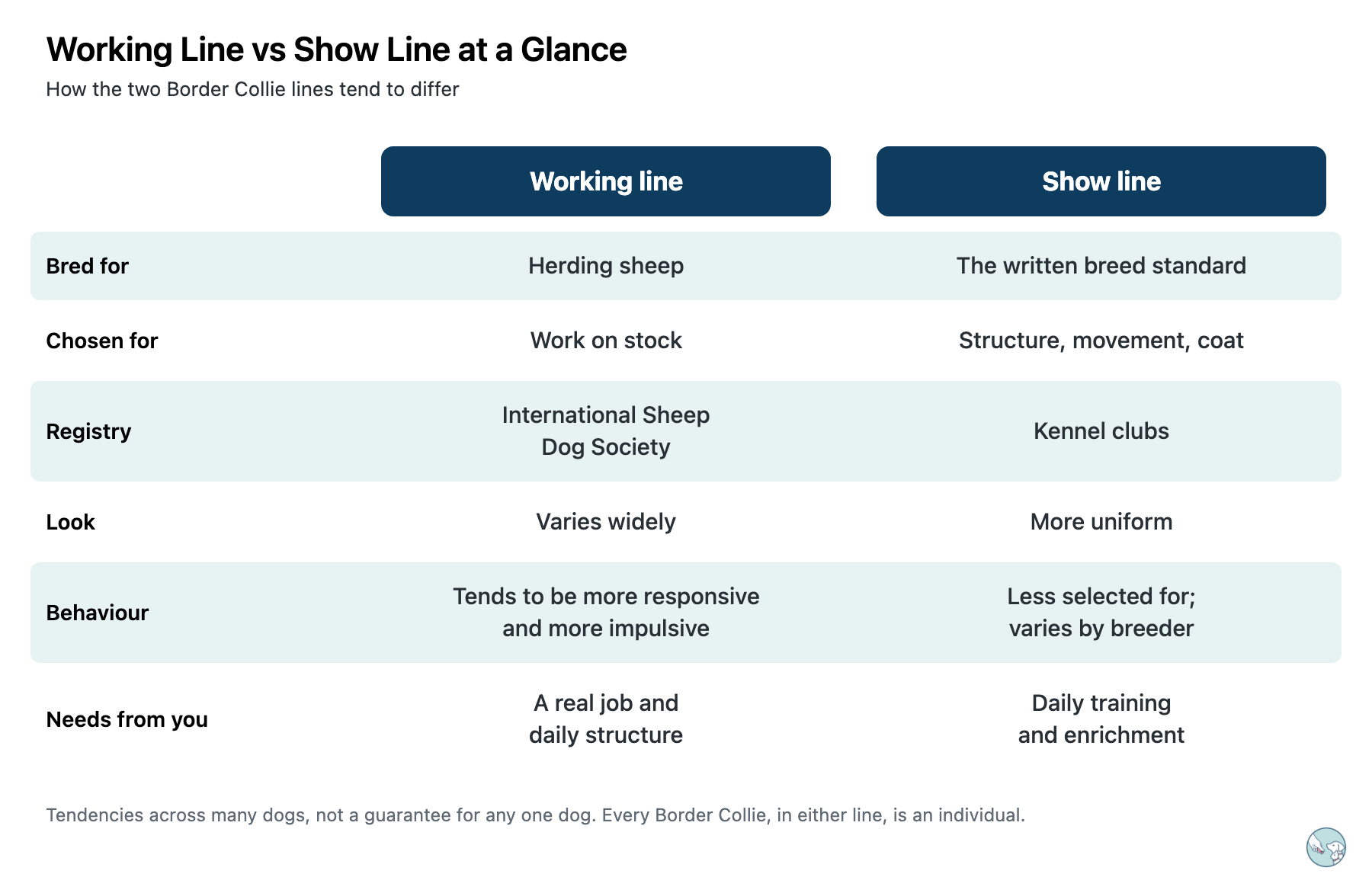
It’s crucial to note that these are tendencies across many dogs. Every dog in either line is an individual, and plenty of dogs don’t match their line’s reputation.
What Each Side Looks For
Working breeders judge a dog on sheep. Looks don’t matter to them; what counts is whether the dog can do the job. Some working registries take this further. One American working registry won’t register a dog on merit if the dog or its parents have been made show champions.
Show breeders see the standard as what keeps the breed recognisable and consistent from one generation to the next. Kennel clubs also run the health-testing schemes many breeders follow, and plenty of show breeders care a great deal about temperament.
The two sides disagree on what a correct Border Collie is. Ask a shepherd and a show judge to pick the best puppy from one litter, and they may well choose different dogs. From where we sit, neither side is wrong for its own goal. The trouble starts when a dog’s breeding goal and its owner’s life don’t match.
What Research Says About Lines
A study of more than a thousand Border Collies and Labradors found that working lines in both breeds were more responsive than show lines. Working Border Collies were also more impulsive than working Labradors. The show lines of the two breeds had become more alike, and the researchers put that down to show lines being bred mostly for appearance, with less selection on behaviour.
Genetics points the same way. A 2025 study found a gene variant, more common in working-line Border Collies, linked to more chasing and grabbing of toys.
Show lines don’t all go the same way, though. In Labradors and Golden Retrievers, show and field lines differed in opposite directions: show Labradors were more curious than field Labradors, while in Golden Retrievers it was the reverse. So a show line can’t be counted on to produce a calm dog.
The differences in these studies are small averages across large groups. A dog’s upbringing, socialisation and learning shape its behaviour at least as much as its line does.
Why This Matters in Singapore
Line, owner and environment all have to fit. Here’s what we see when they don’t.
When You Don’t Know the Line
None of our Border Collie case files records which line the dog came from. Where we know the source, it ranges from a pet shop or an overseas breeder to a friend’s litter, a rescue, or a dog rehomed several times before it reached its current family.
Without that information, an owner can’t plan ahead. A puppy from generations of trial dogs needs a very different first year from a puppy bred for the show ring, and an owner who doesn’t know which one they have tends to find out through problems. If you’re importing a puppy, ask the breeder what the parents do as well as what they look like.
A Working Line in a Flat
Picture a dog bred to watch and control every movement on a hillside, living in an HDB flat next to a park connector full of bicycles and PMDs. Without a daily job, training and an outlet, that drive goes into whatever is available: traffic, joggers, lift doors and shadows. Reacting to moving things was the clearest difference between Border Collies and other dogs in our cases, which we explain in our guide to Border Collie prey drive.
A working-line dog can do well here with the right owner. It suits someone with time, experience and a real outlet. Herding isn’t available locally, so in Singapore that usually means a dog sport or structured obedience work several times a week.
Show Lines in a City Home
Choosing a show line lowers the odds of extreme drive. It doesn’t make the dog easy. Most of the Border Collies in our cases didn’t come from known working lines, and they still showed the movement sensitivity, noise sensitivity and reactions to sudden change that the breed is known for. A show-line Border Collie still needs daily training, mental work and help coping with a busy city.
Border Collie Crosses
In Singapore we see Border Collies crossed with Poodles (often sold as Bordoodles), Samoyeds, terrier types and local dogs. A cross has no breed standard and no breeding goal, so there’s no way to predict which traits it will take from each parent. Littermates can turn out very differently.
Licensed breeders in Singapore have to meet AVS licence conditions on welfare and health, including not breeding dogs with known harmful inherited conditions or breeding close relatives. Licensing doesn’t tell you what the parents were bred for, though. Unlicensed home litters, smuggled puppies and overseas online sellers sit outside even those rules. Crosses also run into housing rules. HDB allows a cross of two approved breeds, and Border Collies aren’t on the approved list, so a Border Collie cross isn’t approved either, even with a Poodle parent.
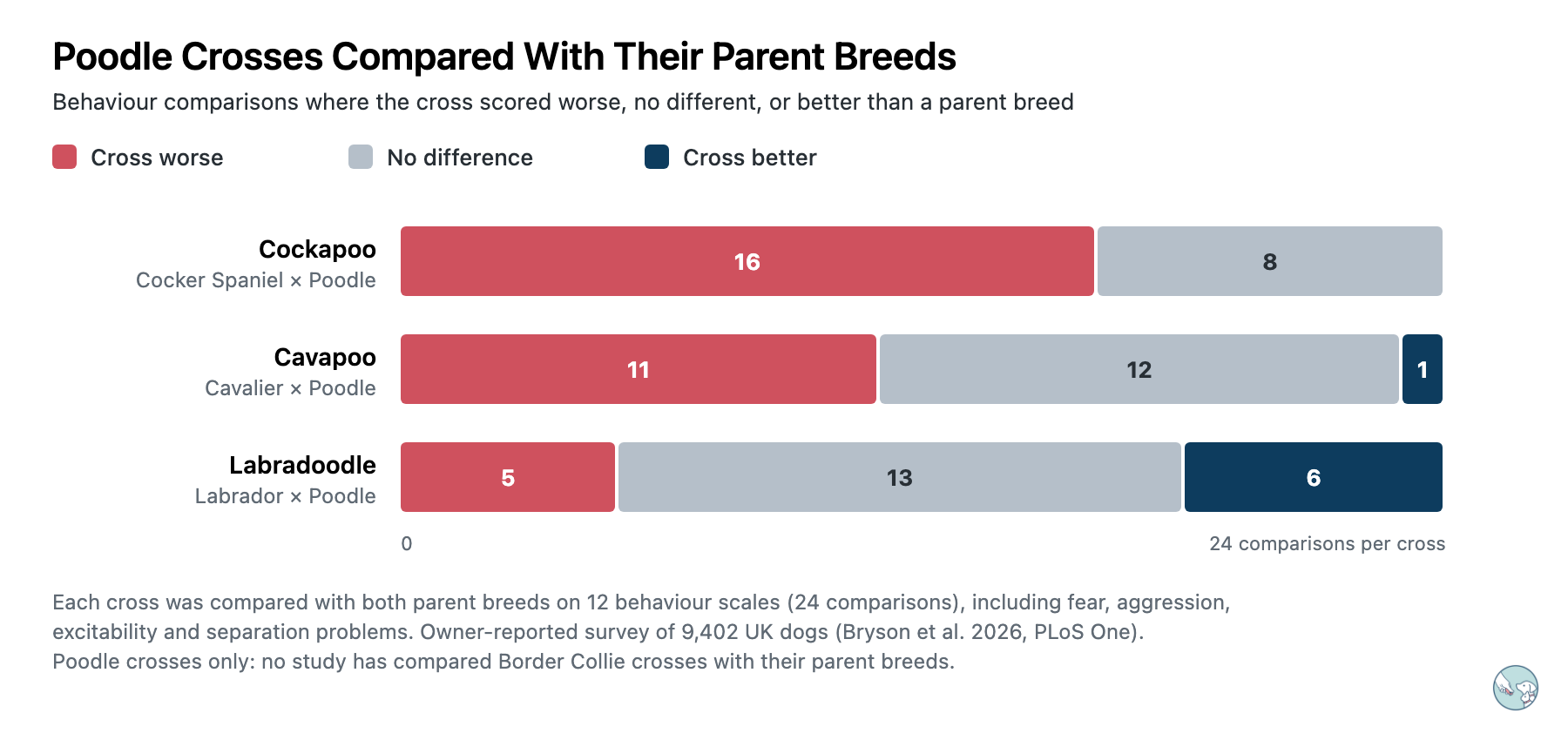
No one has studied Border Collie crosses closely. The largest study so far of designer crosses compared Cockapoos, Cavapoos and Labradoodles with their parent breeds. Where they differed, the crosses usually came out worse, though it varied a lot from cross to cross.
The Border Collie crosses we’ve worked with show how varied they can be. One Border Collie × Poodle has lunged silently at cats, bicycles, joggers, people and dogs since she was a puppy. A Border Collie × terrier, a former stray, learned to fear people in uniform.
A Border Collie × local mix Shafik knows well is full of energy and loves food. He also struggles to contain himself, reacts to dogs up close, and dislikes being touched around the head. Some of that may be learned, and some may come from his parents. Nobody knows his early life, and only one of his parents’ breeds is known, so there’s no way to tell. That uncertainty is what owners of these dogs live with. It makes it hard to know what to expect, or where training should start.
Low Threshold, Low Drive
Two things shape how hard a reactive dog is to help. Threshold is how little it takes to set the dog off. Drive is how much the dog wants food, toys or work. A dog that reacts easily but loves to work gives us plenty to build on, because food and play can be used around its triggers. A dog that reacts easily and has little interest in food or play gives us far less.
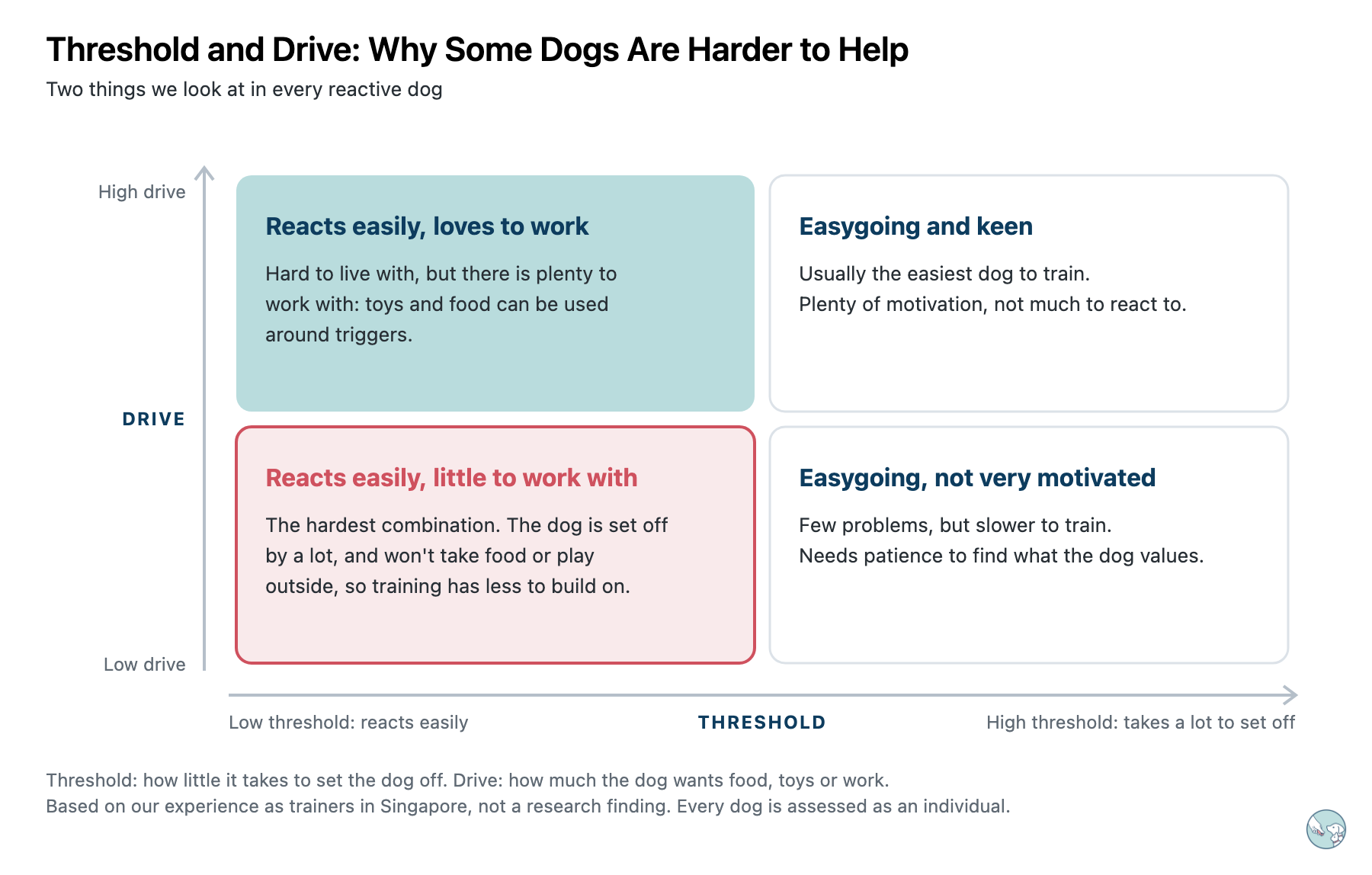
In a cross, the Border Collie’s sensitivity to movement and sudden change can come through without the drive and focus that make the breed easy to train. One Border Collie × Samoyed we work with reacts readily to other dogs and has very little interest in food, even at home. Before we could work on his reactions, we had to build his interest in rewards, first with luring games and then with a ball. His reactions to other dogs are now much more muted, though it took months to get there.
For dogs like this, we start with management to cut down on reactions, then look for anything the dog values and build on it. Our guides to food motivation and play as a reward cover how. Training happens at a distance where the dog can still learn, in small steps.
Choosing a Border Collie
If you’re buying a puppy, ask the breeder:
- What do the parents do: herding, sport, showing, or life as pets?
- Which registry are the parents with?
- Can you see the parents’ health results? For Border Collies, that means hip and elbow scores, a recent eye exam, and DNA tests such as CEA (an eye condition), CL (a brain disease) and TNS (an immune disorder).
- Can you meet the parents, and how do they behave at home?
- How will the puppies get used to traffic, people and noise before they leave?
- If they say “sport-bred”, what does that mean for the puppy’s drive?
Then look at your own life: how much time you have each day, your experience with dogs, the outlet you can offer, and how much noise and traffic there is around your home. If you’re adopting, ask the rescue about the dog’s history, its triggers and how it copes with lifts and traffic. With a cross, treat its temperament as unknown, and plan for Border Collie sensitivity until the dog shows you otherwise.
Frequently Asked Questions
Are working line Border Collies good pets?
They can be, with the right owner. A working-line Border Collie needs daily training, mental work and a real outlet for its drive, such as a dog sport. In a busy home without that, the drive often turns into chasing or reacting to movement.
Are show line Border Collies calmer?
On average, show lines tend to be a little less intense than working lines, but they aren’t reliably calm. Research shows show lines vary by breed and breeder, and a show-line Border Collie still has the breed’s sensitivity to movement and noise.
Is there such a thing as a sport line?
“Sport-bred” is an informal label breeders use for dogs bred for agility, flyball or obedience. There’s no sport-line registry, standard or test. Most sport-bred Border Collies come from working lines, sometimes mixed with show lines.
Is a Bordoodle easier than a Border Collie?
There’s no way to know in advance. A cross can take any mix of traits from each parent, and littermates can differ a lot. Border Collie crosses aren’t HDB-approved, and they can be just as sensitive as a purebred Border Collie.
Help for Your Border Collie
If you’re choosing a puppy, our private puppy sessions help you set up the first months well. If your Border Collie or Border Collie cross already struggles with movement, noise or other dogs, our behaviour consults start by working out what’s driving the behaviour.
Sources
- Ács, V., Bokor, Á. & Nagy, I. (2019). Population structure analysis of the Border Collie dog breed in Hungary. Animals, 9(5), 250. PMC6562970
- Fadel, F. R., Driscoll, P., Pilot, M., Wright, H., Zulch, H. & Mills, D. (2016). Differences in trait impulsivity indicate diversification of dog breeds into working and show lines. Scientific Reports, 6, 22162. doi:10.1038/srep22162
- Jeong, H., Ostrander, E. A. & Kim, J. (2025). Genomic evidence for behavioral adaptation of herding dogs. Science Advances, 11(18). doi:10.1126/sciadv.adp4591
- Sundman, A.-S., Johnsson, M., Wright, D. & Jensen, P. (2016). Similar recent selection criteria associated with different behavioural effects in two dog breeds. Genes, Brain and Behavior. SLU
- Bryson, G. T., O’Neill, D. G., Belshaw, Z., Brand, C. L. & Packer, R. M. A. (2026). Comparing undesirable behaviours between “designer” Poodle-cross dogs and their purebred progenitor breeds. PLOS One, 21(3), e0342847. doi:10.1371/journal.pone.0342847
- International Sheep Dog Society. Home; Registration on Merit
- American Border Collie Association. History notes; Register on Merit Program
- The Royal Kennel Club (formerly The Kennel Club). Activity Register; Border Collie breed information and health tests
- Animal & Veterinary Service (AVS), NParks. Breeders and farmers: general information and licence conditions (includes “Licensing Conditions for Dog Breeding”, 15 Aug 2025)
- Housing & Development Board. Keeping pets
