
A while back, Qiai, our Chief Behaviourist, and I spent a day with Nij Vyas, a championship sheepdog handler, on the land he works near East Norton in Leicestershire. We watched two of his Border Collies, Cap and Kai, move a flock of wild sheep that had never been worked by dogs. The sheep could bolt at any moment. The dogs held them together, moved them where Nij wanted, and split them apart on his word.
I train dogs for obedience, and I’ve written about why Border Collies were bred to work with people. Seeing that work in a real field made it make sense. This article covers what we saw, the skills each part of the job demands, and how one shepherd can run two dogs at once.
Watching Nij Work
Nij is the real thing, with experience of both farm herding and competition. He has won at championship level and judges sheepdog trials. He qualified two dogs for every English National Sheepdog Trials from 2004 to 2009 and has represented England at international level. He also wrote Sheepdog Training and Trials, a guide for Border Collie handlers.
He introduced us to four dogs, Misty, Todd, Cap and Kai. Cap and Kai did the work. The sheep they were moving were wild sheep, unused to dogs or people, and sheep like that panic far more easily than a farm flock that sees dogs every day.
Cap and Kai moved the flock towards us, then away again, and split it into separate groups. Both dogs were completely in tune with Nij and fully focused on the job. Watching two dogs work at once, each moving on its own signals, was the highlight of the day for both of us.
Teaching the Sheep
What surprised me most was that Nij doesn’t only train the dogs. He trains the sheep too.
To a wild sheep, a person is a threat, and simply standing near one puts pressure on it. Nij explained that he waits for a sheep to look towards him or take a step his way. In that moment, he steps back and takes the pressure off. The sheep learns that turning towards the shepherd is what makes the pressure go away, and over time the shepherd becomes the safe place to move towards.
In learning terms, this is negative reinforcement: a behaviour gets stronger because something unpleasant is removed when the animal does it. Here, the behaviour is looking at or moving towards the shepherd, and the unpleasant thing is the shepherd’s pressure.
This changed how I saw the whole picture. Cap and Kai weren’t only working with each other. They were working with Nij, who was shaping how the sheep moved as well. Dogs, shepherd and sheep moved as one system.
Moving Sheep Without Catching
Every sheep has a comfort bubble, known as its flight zone. Step into it and the sheep moves away. Push too deep, too fast, and it panics. Wild sheep have bigger flight zones and panic sooner, which is why the work we watched needed such fine control.
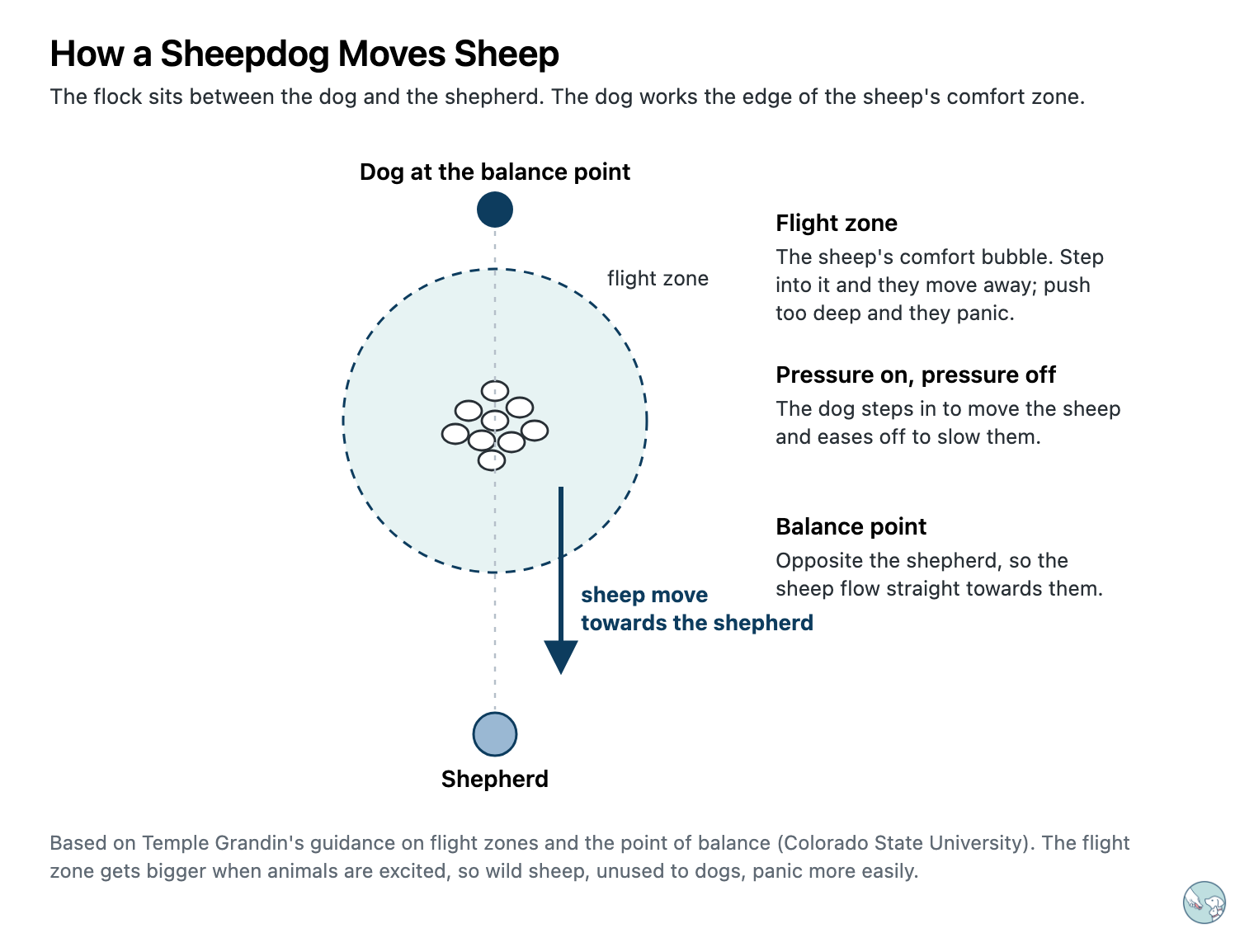
A good sheepdog works the edge of that bubble. It steps in to start the sheep moving and eases off to slow them, the same pressure-and-release idea Nij uses with the sheep himself. Animal scientist Temple Grandin makes the same point in her guidance on livestock handling: alternating pressure works better than constant pressure.
The dog also holds the balance point, on the far side of the flock directly opposite the shepherd. From there, the sheep are held between dog and shepherd and flow straight towards the shepherd. When the sheep have already learned to move towards the shepherd, as Nij’s had, holding balance gets much easier.
The dog does all this without touching the sheep. It uses “the eye”, the intense stare and crouch that herding breeding strengthened from the dog’s hunting instincts, as our article on Border Collie prey drive explains. In a sheepdog trial, a dog that bites a sheep is disqualified.
From Outrun to Pen
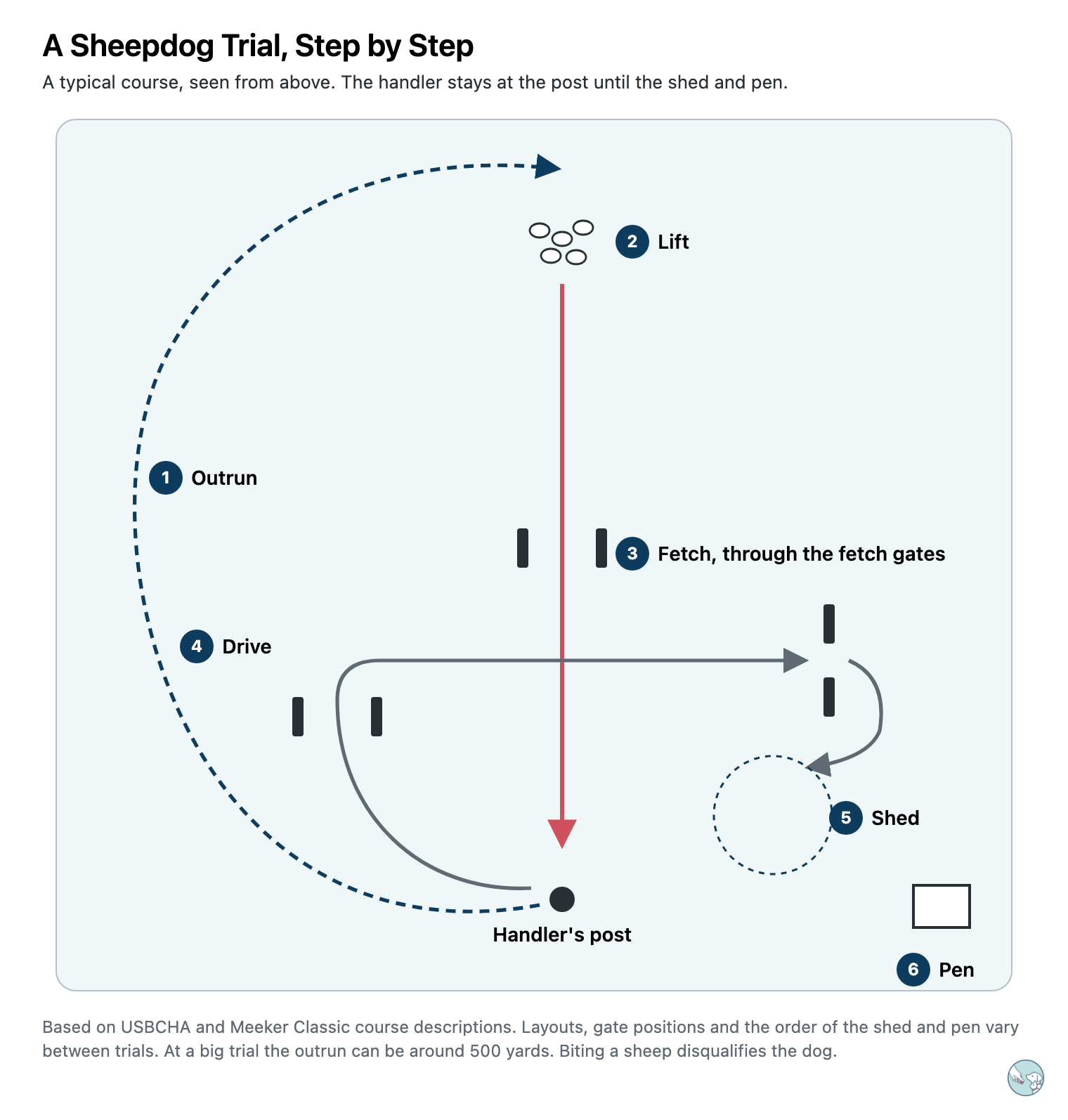
A sheepdog trial is the farm job in miniature, and each part of it asks for a different skill. Judges start every run with full marks and deduct points for every fault, so precision is everything. At a big trial the outrun alone can be around 500 yards, and the order of the later stages varies between trials.
The Outrun
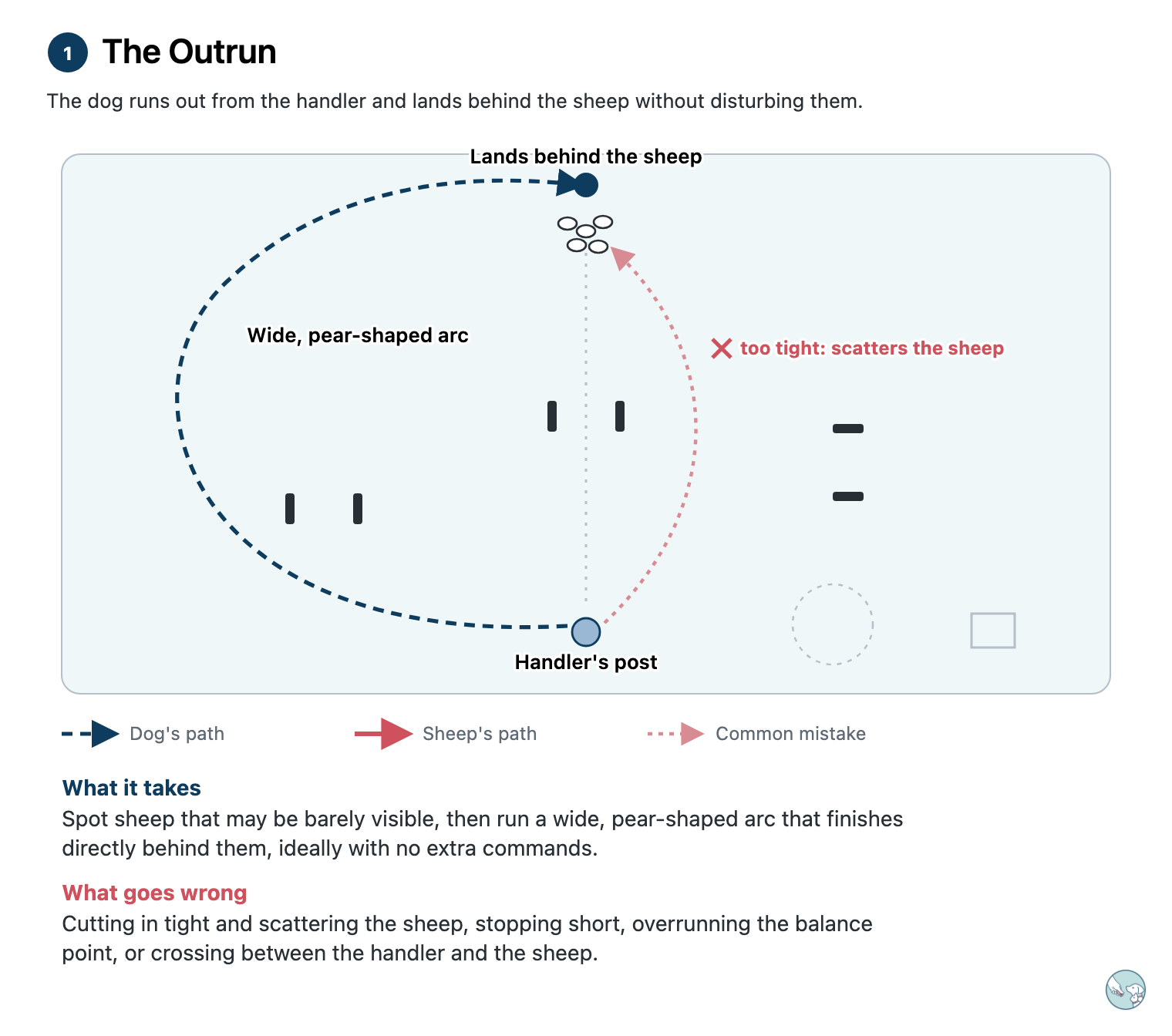
The dog runs out from the handler and lands behind the sheep without disturbing them. It has to spot sheep that may be barely visible, then run a wide, pear-shaped arc that finishes directly behind them, ideally with no extra commands.
Things go wrong when a dog cuts in tight and scatters the sheep, stops short, or overruns the balance point. Crossing between the handler and the sheep is heavily penalised. If the dog starts to come in tight, the handler can whistle it out wider.
The Lift
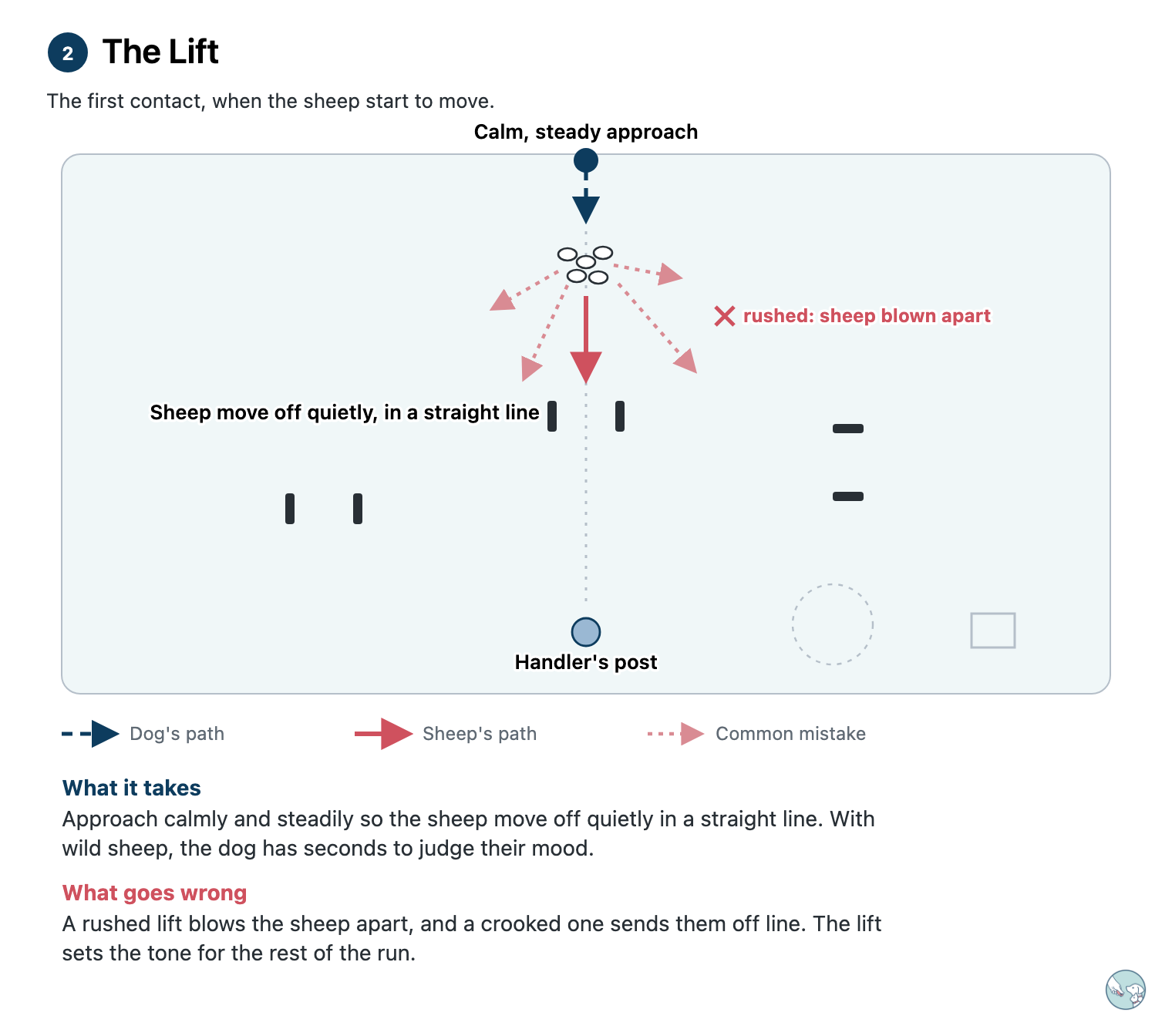
The lift is the first contact, when the sheep start to move. The dog approaches calmly and steadily so the sheep move off quietly in a straight line. With wild sheep, the dog has seconds to judge their mood. A rushed lift blows the sheep apart, and a crooked one sends them off line. The lift sets the tone for the rest of the run.
The Fetch
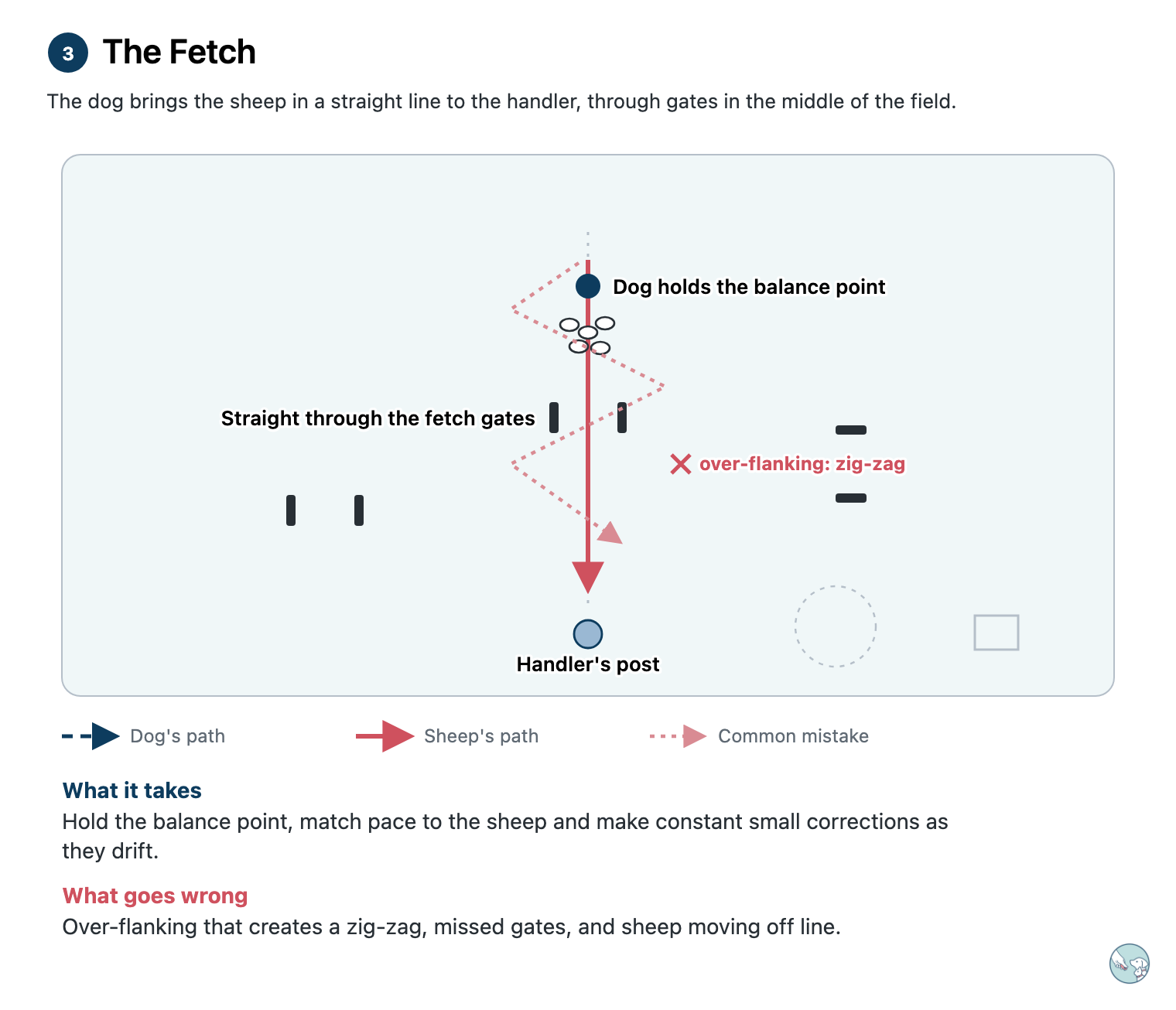
The dog brings the sheep in a straight line to the handler, through a set of gates in the middle of the field. It holds the balance point, matches its pace to the sheep and makes constant small corrections as they drift. Judges deduct for over-flanking that creates a zig-zag, for missed gates and for sheep moving off line.
The Drive
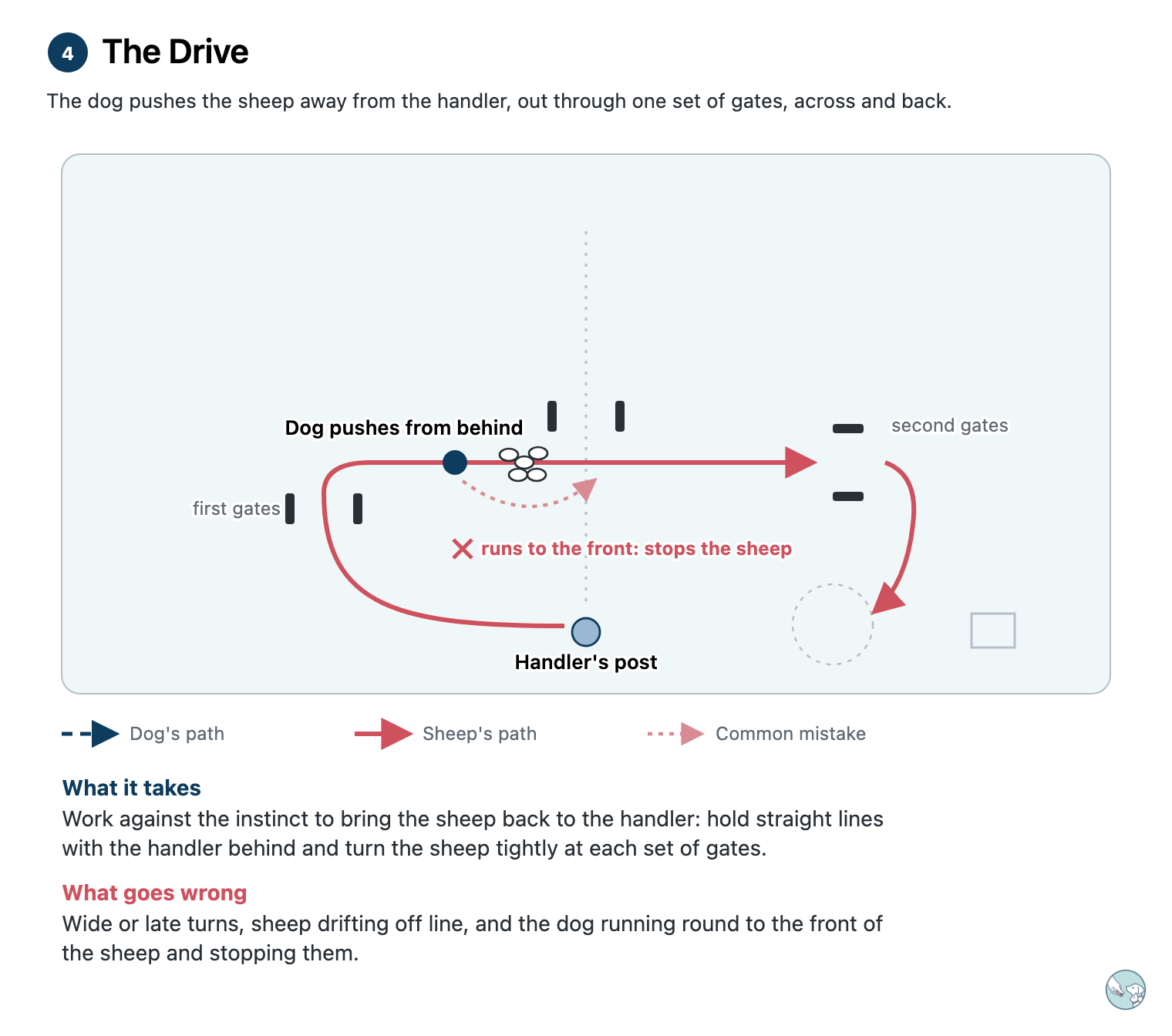
Now the dog pushes the sheep away from the handler, out through one set of gates, across the field through a second set, and back. This is where obedience shows most clearly. Most herding dogs are natural fetchers, always wanting to bring the sheep back to their person, so driving means working against that instinct.
The dog has to hold straight lines with the handler behind it and turn the sheep tightly at each set of gates on the handler’s commands. Common faults are wide or late turns, sheep drifting off line, and the dog running round to the front of the sheep and stopping them.
The Shed
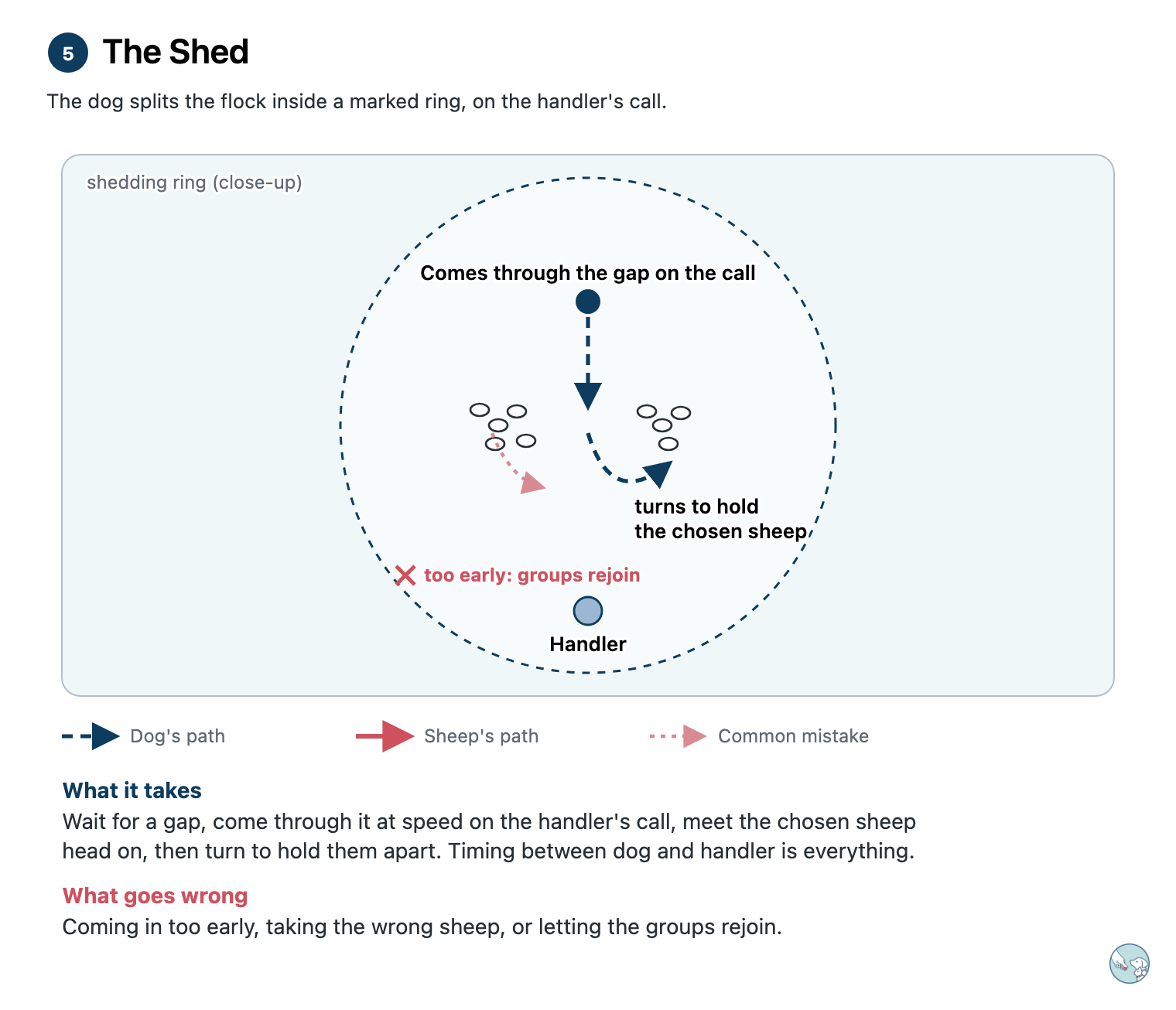
The dog splits the flock inside a marked ring, which is what Cap and Kai did for us. The handler and dog line the sheep up, wait for a gap, and the handler calls the dog through it. The dog comes in at speed, meets the chosen sheep head on, then turns to hold them apart. Everything depends on timing between dog and handler. Coming in too early, taking the wrong sheep or letting the groups rejoin all cost points.
The Pen
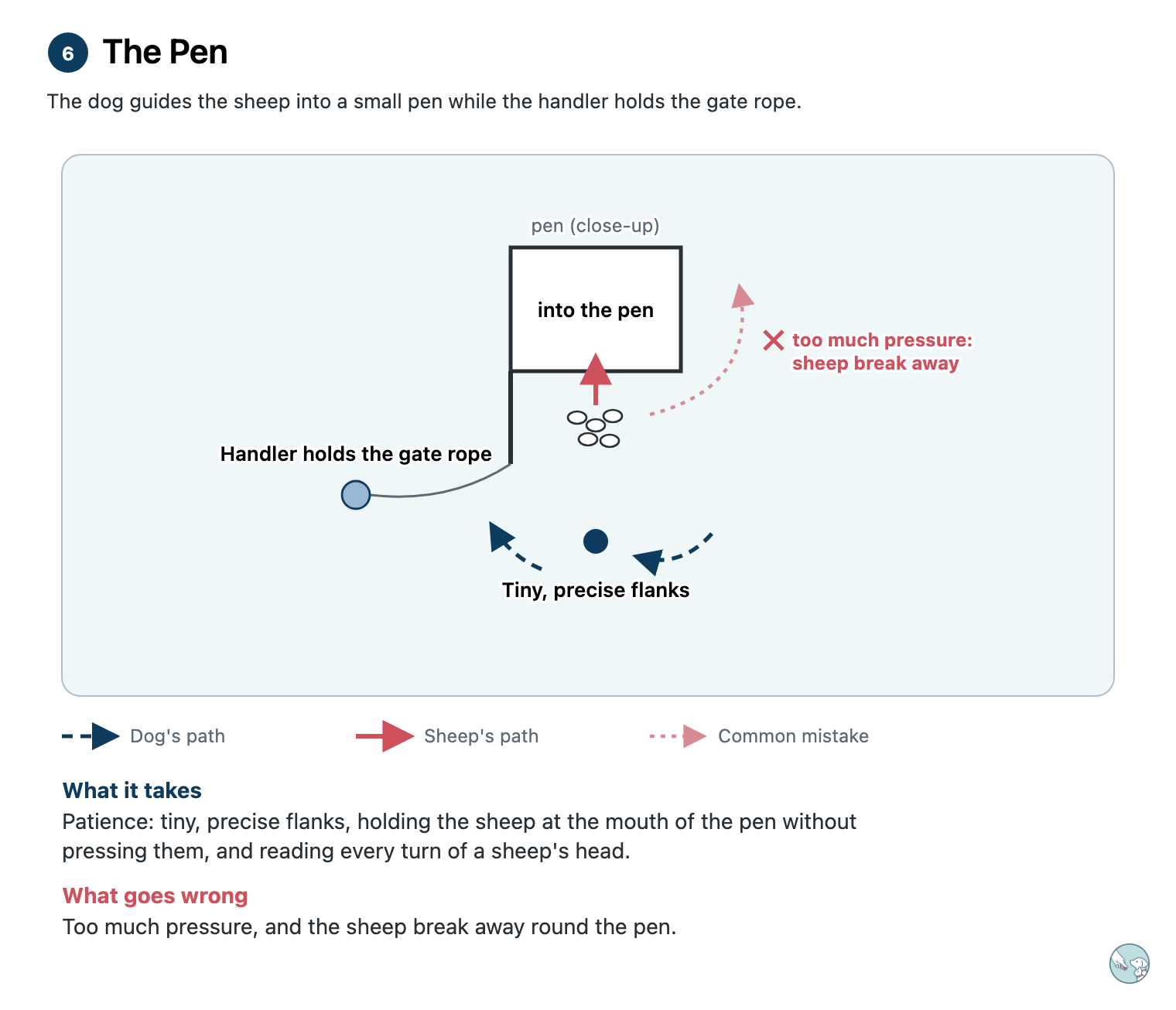
Finally, the dog guides the sheep into a small pen while the handler holds a rope tied to the gate and isn’t allowed to let go. This takes patience: tiny, precise flanks, holding the sheep at the mouth of the pen without pressing them, and reading every turn of a sheep’s head. Too much pressure and the sheep break away round the pen.
One Dog, One Shepherd
All of this runs on a small set of commands. The two most important are the flanks, which send the dog around the sheep in one direction or the other.
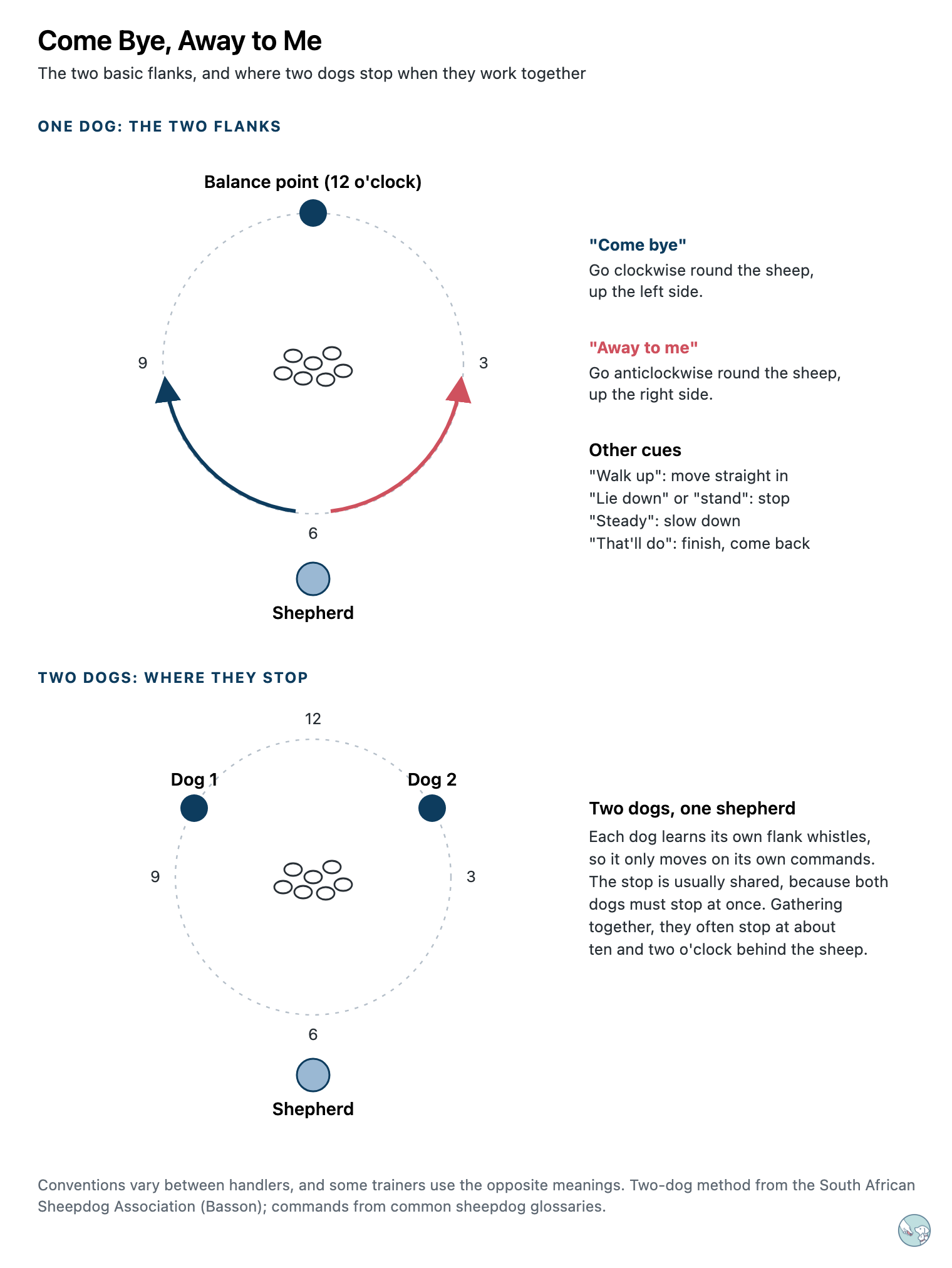
- “Come bye”: go clockwise around the sheep.
- “Away to me”: go anticlockwise.
- “Walk up”: walk straight in towards the sheep.
- “Lie down” or “stand”: stop.
- “Steady”: slow down.
- “Look back”: turn and gather sheep that were left behind.
- “That’ll do”: stop working and come back.
Voice and Whistle
Over long distances and in wind, handlers use whistles in place of words. Each handler builds their own set of whistle sounds, so no two handlers sound quite the same. A good handler keeps the whistles soft for close work and saves sharp, loud tones for distance and emphasis. Conventions vary between handlers, and some even use the flank words the other way round.
A Dog That Thinks
At a distance, the dog can see things the handler can’t, so a good sheepdog makes small decisions of its own. Some trainers let the dog decide whether to stand or lie down when it’s stopped, depending on what keeps the sheep under control. The best sheepdogs combine strict obedience with judgement of their own.
Two Dogs, One Shepherd
Working two dogs at once, sometimes called brace work, raises the difficulty again.
A Whistle for Each Dog
Each dog learns its own set of commands, so it only moves when it hears its own signal. Handlers who run more than one dog give each a different set of whistles. The stop and walk-up are usually kept the same for both, because when the handler stops the work, both dogs must stop at once. Watching Cap and Kai respond to Nij separately, each ignoring the other’s signals, showed how much that takes.
Learning to Work as a Pair
According to the South African Sheepdog Association, the order matters:
- Each dog is trained to a high level on its own first.
- Each learns to ignore the other’s commands. One dog lies beside the handler while the other works, then they swap.
- The dogs learn to feel each other’s pressure on the sheep without crossing sides.
- They gather together, timing their outruns so both land behind the sheep, often stopping at about ten and two o’clock.
- Finally, they drive together.
It doesn’t suit every dog. Dogs with different outrun widths are hard to time, some dogs are too possessive of the sheep to share them and others too sensitive, and handlers swap the dogs’ sides regularly to stop bad habits forming. As the association puts it, “you can ruin a good dog by forcing it to work with another dog.”
With Nij, we saw the whole system together. Cap and Kai worked with each other, and with a shepherd who had already shaped the sheep to move towards him.
Built for Micromanagement
Put the pieces together and a working sheepdog takes a constant stream of small instructions: a half-flank, a stop, a steady, sometimes every few seconds and hundreds of metres away. All the while, it manages its own drive and reads the sheep.
The research on Border Collies in obedience paints the same picture. Breeds bred to work in eye contact with a handler follow human cues better than independent breeds. Border Collies keep a strong urge to chase, but breeding made it controllable. And working registries such as the International Sheep Dog Society have long bred dogs for proven work on sheep. That focus on work is what sets working lines apart, as our guide to working vs show line Border Collies explains.
As an obedience trainer, I see the same qualities in the ring: a dog that watches its handler closely and responds to the smallest cue. It’s crucial to note that this is a breed pattern and doesn’t predict any one dog. Plenty of Border Collies never herd a sheep, and each dog’s abilities have to be judged on their own.
Herding and Your Pet Dog
Most Border Collies in Singapore will never see a sheep, but the traits are all still there: watching every movement, needing a job, and sensitivity to pressure and sudden change. Knowing what the breed was built for makes it easier to understand the dog in your home. Our guide to Border Collie training in Singapore looks at how those traits play out in city life.
Frequently Asked Questions
What does “come bye” mean?
It tells a sheepdog to go clockwise around the sheep. “Away to me” sends it the other way, anticlockwise. Handlers vary, and a few use the words the opposite way round.
How do two sheepdogs work together?
Each dog learns its own set of whistles, so it only moves on its own commands, while the stop is usually shared. Each dog is trained well on its own first, then the pair learn to ignore each other’s signals and share the work.
Do sheepdogs bite the sheep?
A good sheepdog moves sheep with its eye, position and pressure. Breeding toned down the bite in herding dogs, and in a sheepdog trial a dog that bites a sheep is disqualified.
Can a pet Border Collie learn to herd?
Many Border Collies still have strong herding instincts, but herding takes access to sheep and an experienced trainer. In Singapore, the more practical outlets are games and training that give the dog a job.
Help for Your Border Collie
If your Border Collie’s herding instincts show up as chasing bikes or nipping heels, our behaviour consults can help. For obedience, our training programmes build the focus this breed is made for.
Sources
- Vyas, N. (2010). Sheepdog Training and Trials: A Complete Guide for Border Collie Handlers and Enthusiasts. Crowood. Open Library
- Nij Vyas Sheepdog Experience, East Norton, Leicestershire. Tripadvisor
- USBCHA. Trial diagrams and course descriptions; Judging guidelines
- Meeker Classic Sheepdog Championship. Course description
- Basson, F. More than one dog. South African Sheepdog Association. SASDA
- Whistle while you work: why the sheepdog still owns the fields and hills of Britain. Country Life. Country Life
- Sheepdog whistle commands. The Border Collie
- A sheepdog’s glossary. Homestead on the Range
- Tips for teaching driving. American Kennel Club. AKC
- Grandin, T. Understanding flight zone and point of balance for low stress handling of cattle, sheep and pigs. Colorado State University. Grandin.com
- International Sheep Dog Society. ISDS
